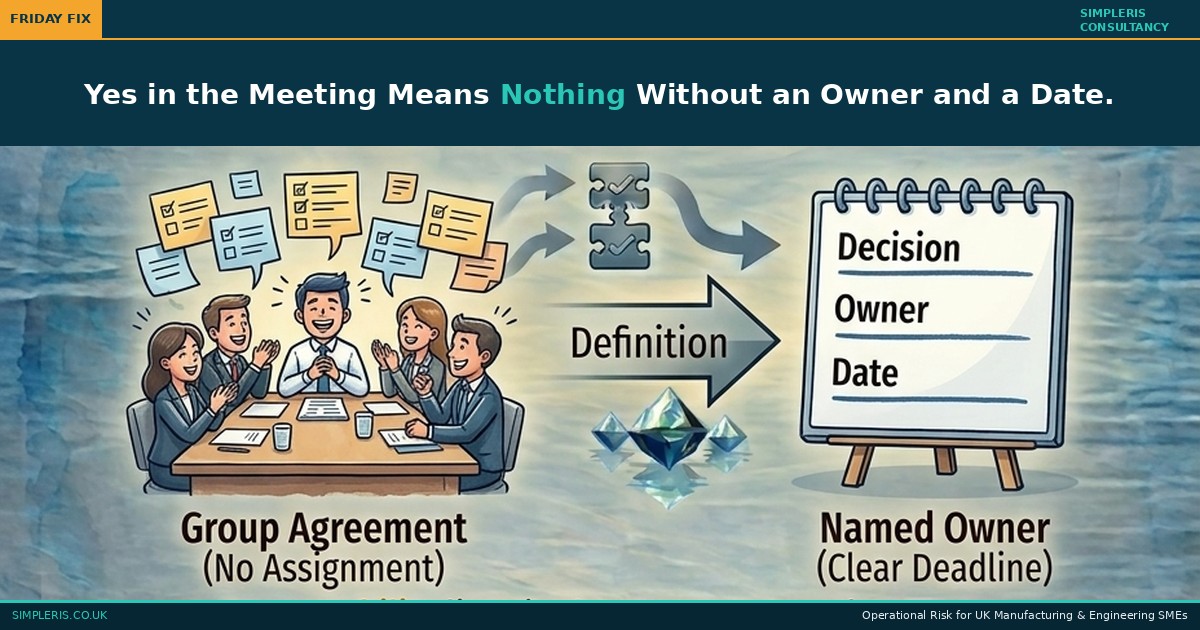
Yes in the Meeting Means Nothing Without an Owner and a Date
The meeting felt productive. Everyone was in the room, the issue was on the table, different views were offered, and by the time people left there was a general sense that things were moving. A week later, nothing had moved. Nobody followed up. When you asked, the honest answer was that people assumed someone else had it covered.
Pain: Everyone says yes in the meeting and nothing happens after.
The agreement around the table was genuine. People intended to act. The problem is not willingness and it is not a team culture issue. The problem is structure. When a meeting ends without naming a specific owner for each decision and a specific date by which it will be done, the outcome lives only in memory. Memory is not a reliable operational system. Whoever felt most responsible leaves hoping the rest will follow. The rest leave assuming that person has it handled.
This is how ownership and decision clarity risk builds in a growing manufacturing or engineering business. It does not arrive in a single event. It accumulates through repeated cycles: the same problem reappears in the next meeting, generates another round of discussion and general agreement, and still produces no assigned action. Over time, the team learns without it ever being said that a decision in a meeting and a decision in the business are two different things. The meetings look active. The work moves slowly. The founder ends up picking up the pieces because no one else did, and everyone thought it was fine to wait.
There is a compounding effect. Once the team stops expecting meeting outcomes to produce action, participation becomes passive. People attend, contribute, and leave without a sense of personal responsibility for what follows. The meeting ritual begins to substitute for the operational outcome it was meant to produce. At that point, scheduling more meetings makes things worse, not better. The volume of discussion increases while the volume of completed work does not.
Fix: End every meeting with one decision, one owner, one date.
One decision names what was actually resolved, in plain language. Not a topic to revisit, not an area to improve, not a general direction of travel. A specific thing that was agreed. One owner is a named individual. Not the team, not operations, not a function. A person whose name you could write next to the action right now. Shared ownership is unowned work. One date is a calendar deadline, not a phrase. "By end of next week" is not a date. "By Thursday 21 August" is.
When all three are written down before the room empties, the outcome is no longer held in memory. It is visible, attributed, and time-bound. The named owner knows they are responsible. So does everyone else who was present. There is no ambiguity about who agreed to take it forward, and no room for the quiet assumption that someone else is covering it.
The habit is straightforward to introduce. Reserve the final two minutes of every meeting for this step only. State the decision aloud: what was agreed, who owns it, when it is due. Write it in one shared place -- your operations system, a running notes document, a brief message sent immediately after. The format matters less than the consistency. Within a few weeks, the team begins to expect this closing step and to self-manage toward it. Follow-up chases become rare. Problems stop being re-opened from the previous meeting. The meetings themselves become shorter because fewer items carry over unresolved. This is what the SYSTEMology framework describes as ownership design: accountability built into the structure of how the business operates, not left to individual memory or goodwill after the fact. When the process creates ownership, you stop relying on the right people remembering to be responsible.
Which decision from this week's meetings still has no named owner and no date attached to it?
This post is part of the Friday Fix series, a weekly operational fix for UK manufacturing and engineering business owners.