Operational Risk

Your business is more exposed
than it looks from the outside

Operational risk rarely looks like crisis. It looks like things taking longer than they should, errors repeating themselves, and growth creating pressure instead of capacity.

Find out where you're most exposed  →
The diagnosis

What operational risk
actually means

Operational risk is the exposure a business carries when it relies on specific people, informal knowledge or reactive problem-solving to get work done, rather than clear, repeatable systems.

It builds quietly in growing businesses. When headcount is small, individual knowledge and effort compensates. But as complexity increases, those informal arrangements become the bottlenecks that prevent consistent delivery.

The risk is not always visible in results. It shows up in the effort required to achieve them.

It is also distinct from the other types of risk a business carries. Strategic risk is about choosing the wrong direction. Financial risk is about cash and capital. Compliance risk is about meeting external requirements. Operational risk is about whether the business can reliably deliver what it has already committed to deliver. It is internal, structural and almost entirely controllable, once it has been made visible.
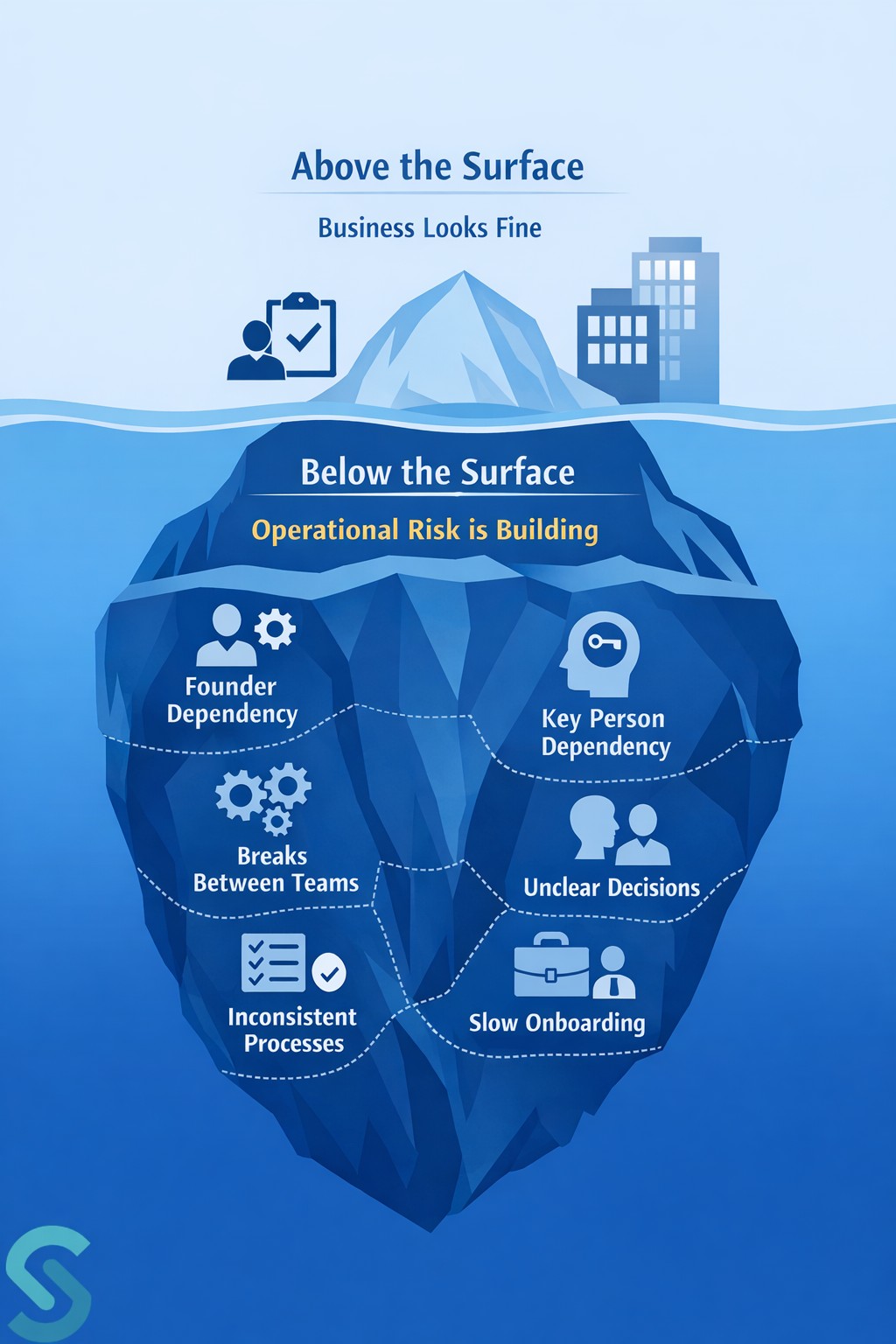
The operational risk iceberg. Above the surface the business looks fine; below it, risk is building.
The complexity gap

Why growth makes
the problem worse

Every business grows in two dimensions: the volume and variety of work it handles, and the systems it uses to manage that work. In most scaling businesses, the first grows faster than the second.

The gap that opens between them is where people, firefighting and guesswork take hold. Work gets done because individuals absorb the pressure, not because the system handles it.

The longer the gap remains open, the more entrenched the informal workarounds become, and the harder they are to replace.

Closing the gap means one of two things: reducing the volume and variety of work the business handles, or increasing the systems and capacity that support it. The first is rarely an option for a growing business. The second is what operational risk reduction does in practice. Each of the six risk pillars below describes a specific way the gap shows up, and what closing it looks like for that pattern.
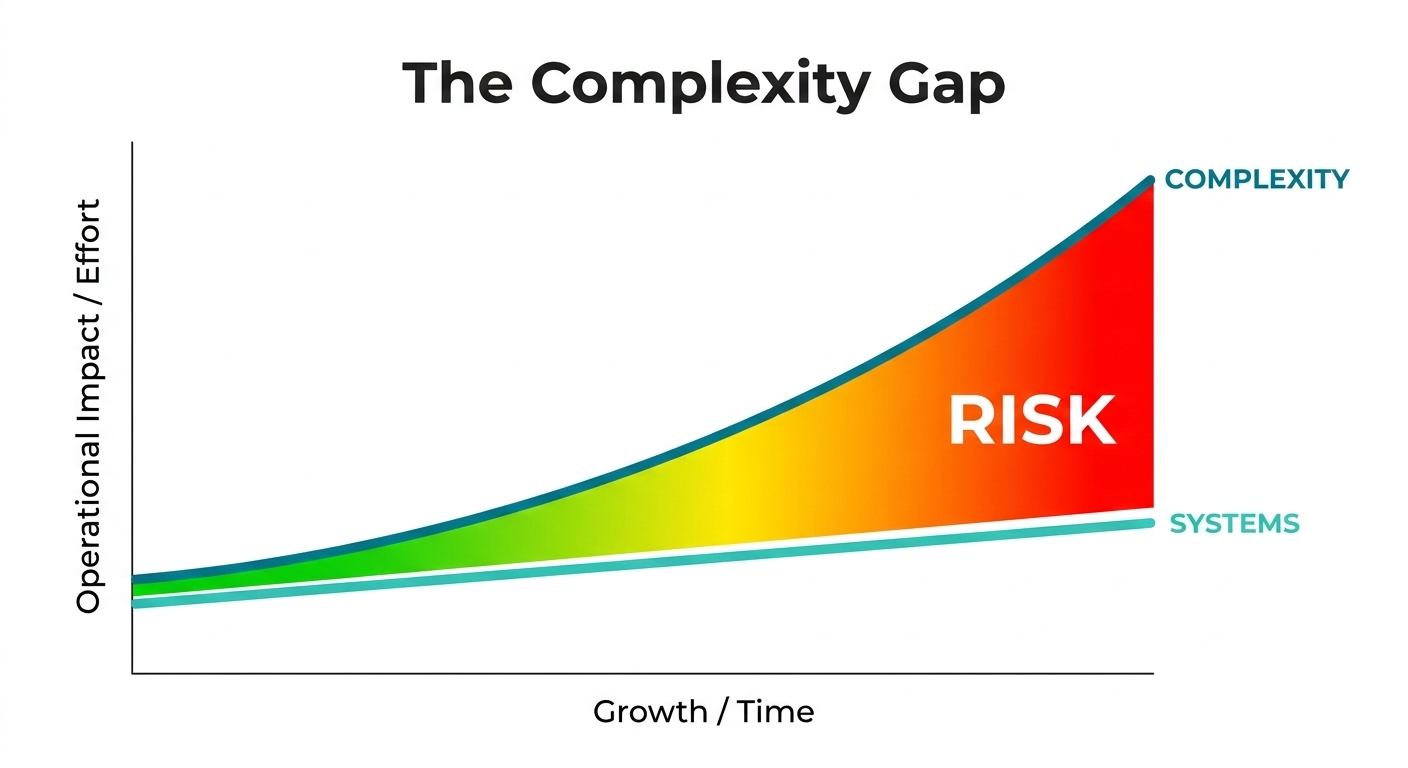
The Complexity Gap. As growth increases, complexity outpaces systems and the gap fills with operational risk.
The six risk pillars

Where operational risk
actually lives in your business

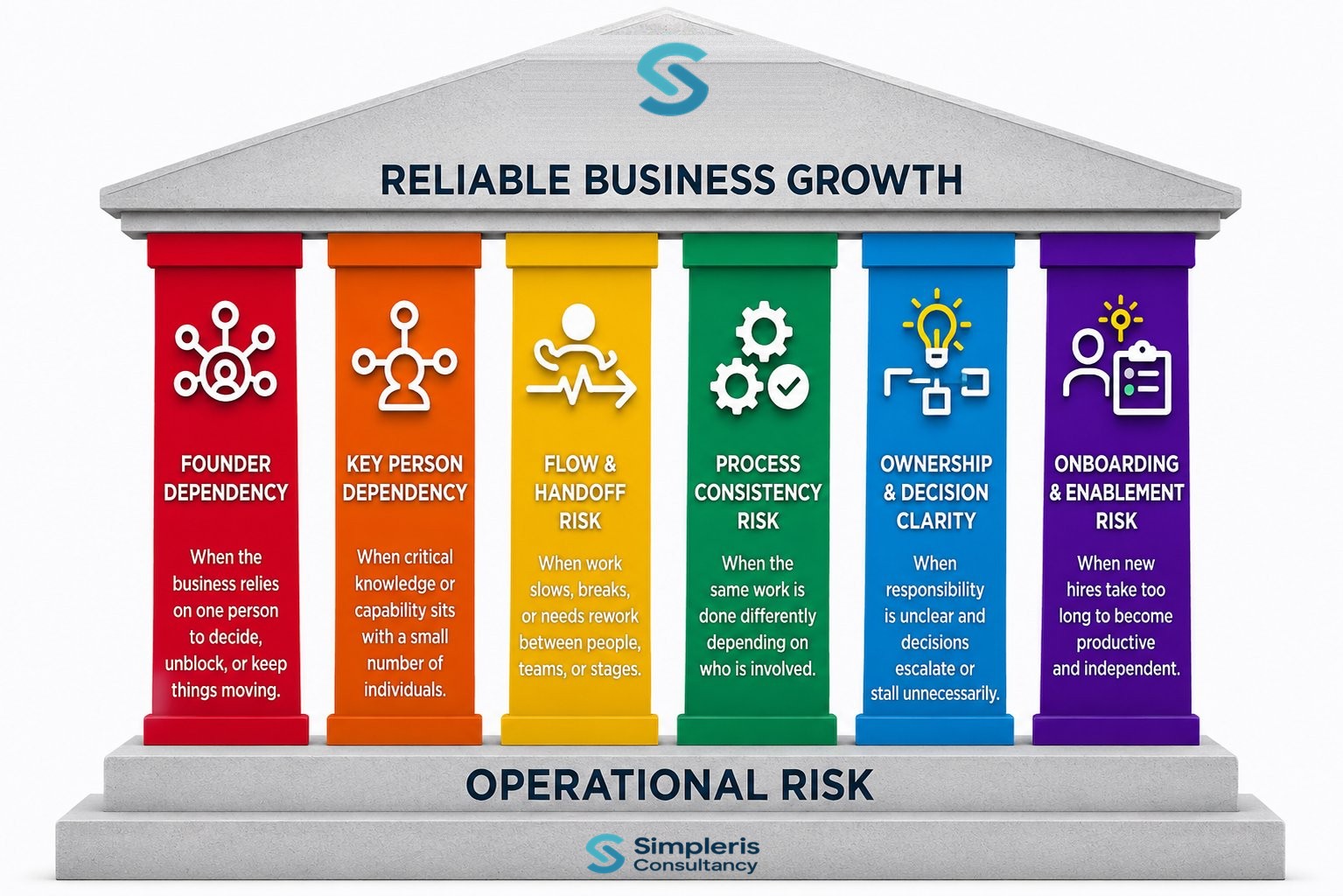
Six distinct areas where reliance on people, firefighting and guesswork builds up. Most businesses are exposed across at least four.

The six operational risk pillars supporting reliable business growth.
Pillar 1
"Why does everything still come through me?"
Founder Dependency
When the founder or leader is the decision point for too many processes, the business cannot operate at full capacity without them. Growth stalls at the ceiling of one person's time and attention. The structural cause is that the business has grown around the founder rather than around systems.
Warning signs
You are copied into emails that don't require your input
Decisions wait until you are available
You cannot take a week off without things slipping
Pillar 2
"What happens if Dave is unavailable?"
Key Person Dependency
Critical knowledge, relationships or skills concentrated in one or two individuals. When those people are unavailable, work stops or quality drops. The business is one resignation or illness away from a serious problem. The structural cause is tribal knowledge that has accumulated without being extracted or distributed.
Warning signs
A specific person is always involved in a process
Knowledge about how things work is not written down
Handover to a new person takes months, not days
Pillar 3
"Why do projects slip between teams?"
Flow and Handoff Risk
Work slows down, stalls or gets lost at the point where it passes between people or teams. Unclear ownership at transition points leads to dropped tasks, duplication and inconsistent output. The structural cause is implicit ownership at transition points, where no one is explicitly responsible for the handover.
Warning signs
Work sits in inboxes waiting to be picked up
Team members are unsure whose job something is
Customers chase for updates because internal tracking fails
Pillar 4
"Why do we keep making the same mistakes?"
Process Consistency Risk
When different people do the same work in different ways, output quality varies and errors repeat. Without consistent processes, every fix is temporary because there is no shared standard to anchor to. The structural cause is work that relies on operator judgement and experience, rather than a shared standard the team can repeat.
Warning signs
The same errors keep appearing despite being addressed
Output quality depends on who does the work
No written standard for how key tasks should be done
Pillar 5
"Why are decisions stalling or being repeated?"
Ownership and Decision Risk
When it is unclear who owns a decision or a process, nothing moves without consensus or escalation. Teams lose time, leaders get pulled back in, and accountability is diffuse. The structural cause is that decision authority has not been explicitly assigned, so escalation becomes the default.
Warning signs
Decisions are revisited repeatedly without resolution
Team members escalate decisions they should own
It is unclear who is responsible for a process outcome
Pillar 6
"Why doesn't hiring fix the problem?"
Onboarding and Enablement Risk
Without a structured way to bring new people up to speed, onboarding relies on existing staff absorbing the load. New hires take months to become effective, and key person dependency grows each time someone leaves. The structural cause is the absence of structured onboarding, so each new hire absorbs the business through observation rather than design.
Warning signs
New hires take 3 or more months to work independently
Onboarding is different each time, depending on who delivers it
Existing team members lose productive time to training
First step

Find out where your business
is carrying the most risk

The free Operational Risk Assessment quiz takes 7 minutes and gives you instant personalised results. Then book a free 30-minute Risk Results Explained session to walk through what they mean.

Find out where you're most exposed  →

Free · 7 minutes.
Risk Results Explained
available free after.