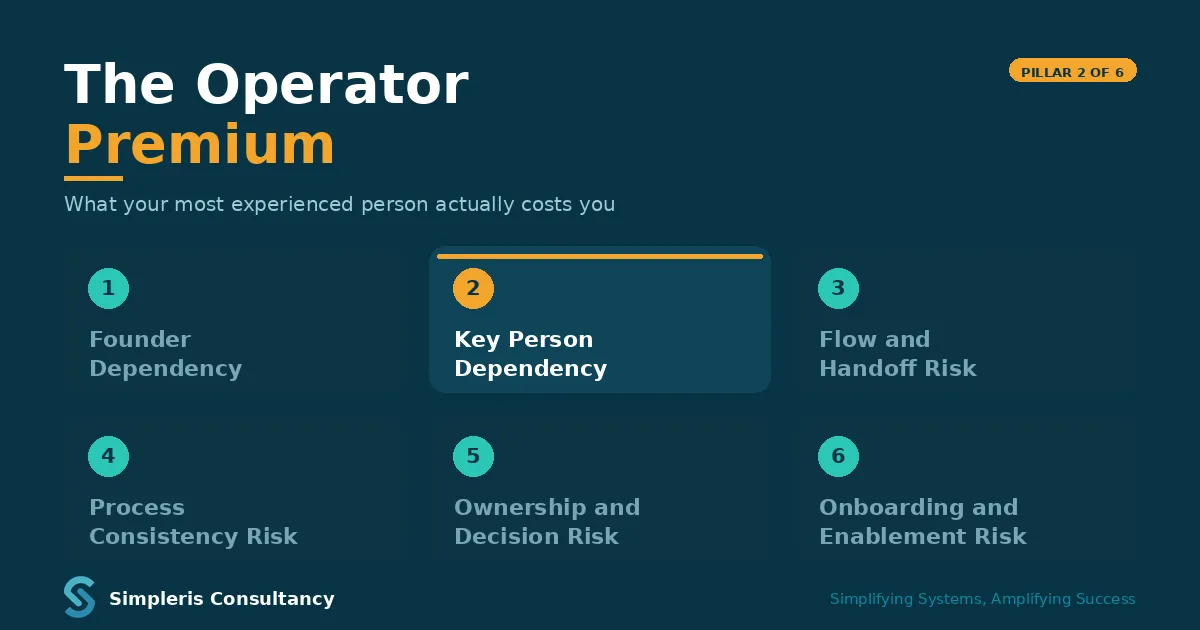
The Operator Premium: What Your Best Operator Actually Costs You
Your best operator looks like an asset. Underneath, they are also a tax on margin, growth and resilience.
Every growing manufacturer has at least one. The operator who has been there the longest, who knows the line, the kit and the customer quirks better than anyone else. The one whose name comes up automatically when something difficult lands. The reason a hard job gets done is often that this person is on it.
That person is real, valuable and irreplaceable in the short term. They are also the reason you are quietly paying what we call the operator premium.
What the Operator Premium Actually Is
The operator premium is the hidden price a business pays when critical knowledge, judgement or capability sits with one or two individuals. It is the gap between what your operation could deliver if the work were systemised, and what it actually delivers given how much depends on one specific person.
You do not see the premium on a payslip. You see it in lines of work waiting for one desk, in customer chases that only one person can answer, in the small drop in output the week that person is off. It is the name of one structural problem with many invoices.
In our framework this is Key Person Dependency. It is one of the six operational risk domains that quietly build as a manufacturer scales, and it almost always grows in step with the senior people you most rely on.
What It Actually Costs You
The operator premium gets paid out across four lines of the business.
Margin. Work queues behind one person. Other people wait, switch tasks, or do something less productive while a job sits. Switching costs and idle time are not on any invoice, but they are real, and they compound.
Growth. The business can only take on what your most loaded operator can personally absorb. Beyond that, quality slips or lead times stretch, and you turn work down or take it on at a worse standard. The ceiling on revenue is set by one person's calendar.
Resilience. One holiday, one illness, one resignation, and the schedule wobbles. The business sits one bad week away from a major customer noticing.
Wage drift. The more uniquely valuable a single operator is, the more leverage they have, and the more expensive they become to retain. That is fair, and it is also expensive. The premium quietly rises over time.
Most owners feel the first two. The second two only become visible in a crisis.
How to Tell if You Are Paying It
Three signs you are paying the operator premium right now.
A specific name comes up for a specific kind of work, every time. Conversations end with "give it to that person" because nobody else can yet be trusted with it.
When that person is off, the standard slips, or work waits for their return rather than being reassigned. Their absence is a soft pause on a part of the operation.
Handover to a new starter, or to a peer who could in principle do the same work, takes months not days. Nobody has captured how the operator actually does the work, so a new person learns by sitting beside them.
If two or three of those are true in a particular work area, the premium is being paid in that area.
Why It Builds, and Why It Sticks
Key Person Dependency is rarely anyone's fault. It is what naturally happens when a business grows faster than its systems. Experienced people absorb complexity because they can, the work gets done, and so the gap between what the operator knows and what is written down widens quietly with each new product, customer or process variant.
By the time someone notices, the knowledge is deep, distributed across years of small judgement calls, and almost invisible to the people who hold it. They cannot easily explain how they know what they know. So the documentation never quite gets done, and the dependency stays in place.
The fix is not to replace the operator. It is to extract what they know, in small enough pieces that doing so does not feel like writing a book, and make it usable by other people.
What Changes When You Address It
A business that has reduced Key Person Dependency in a critical area looks different in three ways.
Workload distributes. Two or three people can do the work to a known standard, so queues clear faster and the operator's calendar stops being the ceiling.
The standard travels. New starters reach useful in weeks instead of months, because they learn from a documented way of working, not from a single individual's habits.
The premium drops. The business is no longer one resignation away from a problem, and the most experienced operator becomes a leader and trainer rather than a single point of throughput. That is a better job for them and a better business for you.
This is what operational risk reduction actually changes in a growing business, one critical workflow at a time.
See Where Your Risk Is Hiding
Most growing manufacturers are paying the operator premium in at least one area and do not know which one is costing them most. We built a free Simpleris® Operational Risk Assessment to make it visible. It takes about seven minutes, scores your business across all six domains including Key Person Dependency, and shows you where the premium is biggest right now.
If you would like help making sense of the result, the assessment is followed by an optional 30-minute Risk Results Explained session, where we walk through your scores and the two or three areas worth tackling first.
For the wider picture across all six places operational risk hides, see The Six Places Operational Risk Hides in a Growing Manufacturing Business. And for the people-side version of the same problem in a different shape, Passing the Bus Test is a good companion read.
The goal is the one every owner of a growing business is really chasing: an operation that runs on predictable systems, not individual heroics. When your business works without you, and without any single operator, you finally gain the freedom to lead the future.
Once you have priced the operator premium, the next question is how to reduce it. See Why Cross-Training Fails (and the Smaller Thing That Works).