Why Cross-Training Fails (and the Smaller Thing That Works)
Most owners treat cross-training as the answer to key person dependency. Train a second person, share the load, sleep a little easier.
It rarely works. Six months on, the same operator is still the one everyone asks. Only one person really knows how to run that machine, and if they were off tomorrow, you would be in serious trouble. Cross-training was supposed to fix that. It usually does not.
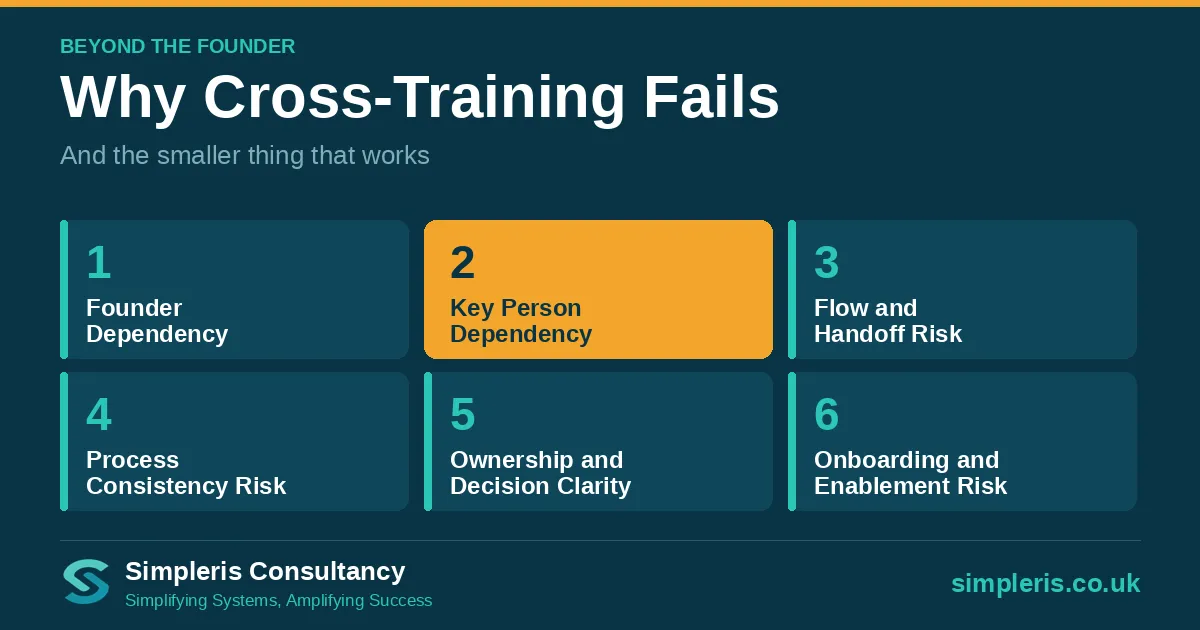
Cross-training fails for a reason that has nothing to do with effort. It tries to copy a person, when the thing you actually need to copy is what that person knows. This is Key Person Dependency, and it is one of the six domains of operational risk we help growing manufacturers reduce.
Why Cross-Training Feels Like the Obvious Fix
When one person holds the line together, the instinct is to grow a second one just like them. Pair them up. Let the junior shadow the expert for a few weeks. Assume the knowledge will rub off.
It is a fair instinct. Cross-training is cheap, it needs no new system, and it feels like progress. For a while it even looks like it is working.
Then your best operator takes a week off, and the line gets twitchy anyway.
What Cross-Training Actually Misses
Shadowing moves attention, not knowledge. The second person watches the work being done, but the part that matters stays invisible.
What makes your best operator good is rarely the obvious steps. It is the small judgement calls. The setting they nudge when the material runs warm. The supplier they never quite trust. The order they switch to when the schedule slips.
None of that shows up while you watch. It surfaces only when something goes wrong, and by then the expert has handled it on instinct. The learner sees a smooth recovery, not the decision behind it.
So you end up with two people who can do the job on a good day, and one who can still rescue it on a bad one. The dependency has not moved. You have just hidden it better. Knowledge that lives in someone's head is still knowledge that lives in someone's head, whether one person holds it or two. If you have not yet seen what that one operator actually costs you, that is the place to start.
The Hidden Cost of Training a Second Person
There is a second problem. Cross-training does not just fail to reduce the risk. It can quietly double it.
Now two people carry the same undocumented knowledge in their heads. When they disagree, there is no reference to settle it, so the work drifts. Two versions of right is how process inconsistency creeps in beside the key person dependency you were trying to reduce.
Train a third and a fourth, and the drift compounds. You have spread the knowledge without ever making it stable. A business where critical knowledge sits with two or three individuals instead of one has not solved the problem. It has just made it harder to see. Any one of them can still hold the schedule hostage on a bad week.
"We Can't Afford to Cross-Train, There's No Time"
This is the objection that stops most owners before they start, and it is a reasonable one. A proper cross-training programme, weeks of shadowing per person, genuinely does not fit around a live production schedule.
The good news is that the fix in this post is not that programme. It does not ask you to free up a second person for weeks. It asks for one hour, with one person, to capture three or four decisions. That is a smaller commitment than a single afternoon of shadowing, and it produces something that shadowing never does: a reference that outlives the conversation.
The Smaller Thing That Works
The fix is smaller and less glamorous than a training programme. You capture the critical few decisions, not the whole job.
Start with the work that would hurt most if your key person were off on Monday. Not everything they do. The handful of moments where their judgement is the difference between a good day and a bad one.
Record them doing exactly those moments. Ask why at each decision, the part that lives in their head. Write it down as a short reference: the trigger, the call, the exception. One page, not a manual.
That reference is the asset. It outlives the person. A second operator following it does not need ten years of instinct, because the instinct is now on the page. When the expert is off, the line has something to hold onto that is not a memory. This is the heart of how we reduce operational risk for our clients: capturing what makes a person good, rather than hoping a copy of them appears.
How to Start This Week
Pick one person. Ask yourself a blunt question: who would leave the biggest gap if they called in sick tomorrow? Whose department would everyone say relies on one name?
Then pick one task they own, the one with the most judgement baked in. Sit with them for an hour while they do it, and capture the three or four decisions that are written down nowhere.
You will not reduce key person dependency in an afternoon. But one captured decision is worth more than a month of shadowing, because it is the first piece of knowledge that no longer depends on a single head. The same logic runs through Key Person Dependency in Manufacturing, if you want the version that starts from the question rather than the fix.
Related: One Person Runs Your Month-End Close
Related: When the Line Gets Twitchy Because One Person Is Off, the Knowledge Has Not Been Captured
Find Out Where You Are Most Exposed
Most owners underestimate how concentrated their operational risk is until they measure it. The free Simpleris® Operational Risk Assessment shows you where your business is most exposed across all six domains, in about seven minutes.
Simplifying systems, Amplifying success.