Six Places Operational Risk Hides in a Growing Manufacturing Business
Growth rarely breaks a business in one loud event. It breaks it quietly, in six predictable places, and this is where to look first.
From the outside, the business looks healthy. Orders are up, the team is busy, customers are being served. Underneath that, most owners of a growing manufacturer can feel something else. Too much still depends on a handful of people, yourself included. A good week and a bad week look very different, and you cannot always say why. Growth is creating more pressure, not more capacity.
That feeling has a name. It is operational risk, and it is the quiet threat that scaling manufacturers rarely see coming until it costs them.
What Is Operational Risk in a Manufacturing Business?
Operational risk is not health and safety, and it is not insurance. Most of what you will find written about "operational risk" is finance or compliance language, built for banks and large corporates, and it has almost nothing useful to say to a UK manufacturer with 5 to 50 staff.
In a growing manufacturing business, operational risk is something more ordinary and more expensive. It is the dependency, inconsistency and fragility that build up as the business gets more complex than the people running it day to day realise.
Picture an iceberg. Above the waterline the business looks fine. Below it, risk is building where you cannot see it. Most owners only notice when something breaks the surface. A key person resigns. A major order slips. A customer complains about work that used to be reliable. By then the risk has been there for months, quietly setting the ceiling on how fast the business can grow.
Manufacturing carries a version of this risk that office-based service businesses do not. A handoff on a factory floor is a physical thing: a job travelling between a quoting desk, a production cell and a despatch bay, often across shift changes, with fewer chances to catch an error before it reaches the customer. A generic "operational risk" article written for a professional services firm will talk about workflow software and communication norms. It will not tell you what to do when the person who understands your CNC setup sheets is on holiday, or when a defect that should have been caught at goods-in reaches a customer three weeks later. That gap is why manufacturing-specific guidance matters more here than in most sectors.
What Are the Most Common Types of Operational Risk for UK Manufacturers?
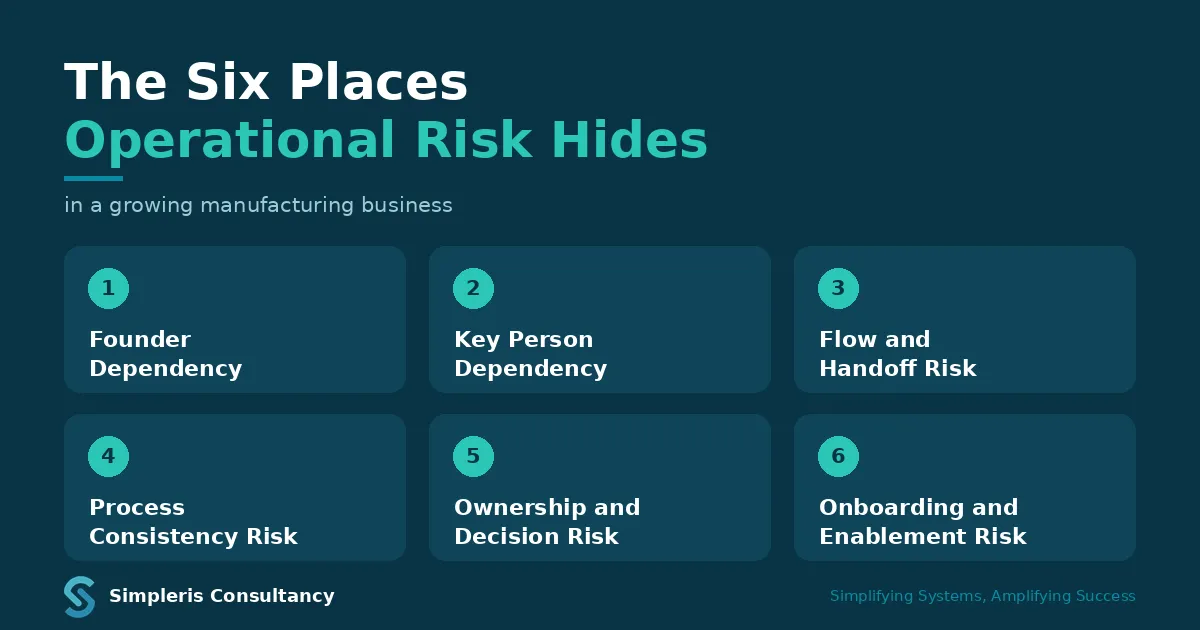
In an operations-led manufacturing business, operational risk concentrates in six recurring domains. Once you can see them, you can manage them, in roughly this order of how often they show up first:
Founder Dependency: decisions, approvals and judgement calls all flow through one person.
Key Person Dependency: critical knowledge or skill sits with one or two employees, not you.
Flow and Handoff Risk: work stalls or disappears as it passes between people, teams or stages.
Process Consistency Risk: the same job produces different results depending on who does it.
Ownership and Decision Clarity: responsibility is unclear, so decisions stall or bounce back to you.
Onboarding and Enablement Risk: new hires take too long to become genuinely productive.
Every growing manufacturer carries some exposure in all six. What varies is which one is costing the most right now, and that is rarely the one that feels loudest.
How Do I Know If My Manufacturing Business Has an Operational Risk Problem?
You do not need a formal audit to get a first read. Answer honestly against each of the six domains below. The more of these that sound familiar, the more operational risk is already shaping how your business runs.
Does the business stop, or slow noticeably, when you take a day off?
Is there a name everyone says when a particular problem comes up, because only that person can fix it?
Does work sit in the gap between two teams until a customer chases it?
Does the same defect or mistake keep coming back after you thought it was fixed?
Does a decision sometimes sit for days because nobody is sure it is theirs to make?
Is your newest hire still asking questions you would have expected them to have answered by month two?
If two or more of these are true, the business is not broken. It has simply outgrown the informal ways of working that got it here, and operational risk is the name for that gap.
As a rough guide: one or two "yes" answers usually means an isolated fix will do. Three or four means one domain is genuinely costing you, and it is worth confirming which one before you act. Five or six means the risk is spread across the business, and guessing which domain to fix first is likely to waste effort on the wrong one. The free Operational Risk Assessment gives you a precise score across all six domains in about seven minutes, rather than a rough gut feel.
What Are the Six Pillars of Operational Risk in a Growing Manufacturer?
1. Founder Dependency
This is the business relying on one person, usually you, to decide, unblock or keep things moving.
The tell: when you take a day off, the questions still find you. Decisions wait. The business runs at your pace, not its own.
It feels like commitment, and for a while it works. But it caps how large the business can become, and it leaves the whole operation depending on one person. We looked at this closely in Why Does My Business Stop When I Take a Day Off?
2. Key Person Dependency
This is critical knowledge, skill or relationships sitting with one or two individuals who are not you.
The tell: there is a name everyone says when a certain problem comes up. If that person is off, that work slows or stops.
Experienced people are an asset. The risk is not the person. It is that the knowledge lives in their head and nowhere else, so the business cannot run without them and cannot grow faster than they can personally cover. See Passing the "Bus Test" to check your own exposure, The Operator Premium for what this dependency costs in margin and resilience, and Why Cross-Training Fails (and the Smaller Thing That Works) before reaching for the usual fix.
3. Flow and Handoff Risk
This is work slowing, stalling or falling through the cracks as it passes between people, teams or stages.
The tell: a job sits in the gap between sales and production, and nobody notices until the customer chases it.
Every handoff is a point where information gets lost and time leaks away. As volume grows, the cracks between teams widen faster than the work inside them. See Why Does Work Keep Falling Through the Cracks Between My Teams?
4. Process Consistency Risk
This is the same work being done differently depending on who does it.
The tell: the same defect appears every few months, you fix it, and it comes back. Quality dips whenever a certain person is away.
When consistency depends on experience rather than a clear standard, every result is a small gamble. Rework rises, margin falls, and you cannot reliably promise a customer what the business cannot reliably repeat. See Why Do We Keep Fixing the Same Problems? for how to create SOPs that actually get used, and Undefined Processes Fail People, Not the Other Way Around.
5. Ownership and Decision Clarity
This is responsibility being unclear, so decisions stall or escalate instead of flowing.
The tell: a decision sits for three days because nobody is sure it is theirs to make. Everyone agrees in the meeting, and nothing happens afterwards.
When everyone owns something, no one owns it. Work without a clear owner is work that quietly waits, and it usually waits on you. See Why Won't My Team Make Decisions Without Me? for how to delegate decisions without losing control, and Clarity Is an Operational Requirement, Not a Luxury.
6. Onboarding and Enablement Risk
This is new hires taking too long to become genuinely productive and independent.
The tell: your last recruit was still asking the same questions four months in, and getting them up to speed pulled your best people off their own work.
Slow onboarding is expensive twice. Once in the months a new person is not yet contributing, and again in the experienced hours spent carrying them. It is also the clearest sign that the business runs on people, not systems. See Why Does It Take Six Months for a New Hire to Actually Be Useful? for how to fix onboarding without an HR department, and Four Months In, Still Asking Questions.
Why the Six Domains Compound
These domains are not independent, and they are not static. Operational risk is cumulative.
There is a name for the space they live in: the complexity gap. It is the widening distance between the volume and variety of work the business handles, and the systems it has to support that work. As you grow, the gap widens, and risk pools inside it.
Founder Dependency slows onboarding, because new people learn from you. Process Consistency Risk feeds Key Person Dependency, because the standard lives in someone's head instead of the business. Without Ownership and Decision Clarity, handoffs leak, because no one is accountable for the gap between teams.
Growth does not close the complexity gap. It widens it. Every new hire, product line and customer adds complexity, and complexity finds the weakest of the six domains first. That is why adding people so often adds chaos instead of capacity.
This is also why fixing the domains in isolation rarely works for long. A business that documents its processes but leaves ownership unclear will still watch decisions stall, because nobody is confident enough to act on the document without checking first. A business that reduces Key Person Dependency in production but leaves onboarding informal will simply grow a new key person in twelve months. The six domains need to be seen as one system, even when you are only fixing one of them at a time.
How Do I Reduce Operational Risk Without a Full Risk Management Programme?
You do not need a formal risk management function to make real progress. You need three things, in this order.
Find out where your risk actually concentrates. Not where it feels loudest, but where it is genuinely highest. Most owners guess wrong, because the domain causing the most damage is rarely the one generating the most noise day to day.
Fix the highest-impact domain first, not all six at once. The most effective improvements come from addressing one or two domains properly, not spreading thin effort across all six simultaneously.
Build the smallest system that removes the dependency, then test it without you. A written decision rule, a documented handoff, a defined standard. Small, specific, and proven to hold when you step back, rather than a thick binder nobody reads.
None of these three steps require hiring a risk manager, buying software, or setting aside a quarter for a formal programme. They require an accurate starting picture, a decision about where to spend limited time, and the discipline to build something small enough to actually finish.
We built a free Operational Risk Assessment to do exactly that. It takes about seven minutes, scores your business across all six domains, and shows you where risk is building and where to look first. No preparation, and no pitch.
If you would like help making sense of your results, the assessment is followed by an optional 30-minute Risk Results Explained session, where we walk through your scores and the two or three domains worth tackling first.
The goal is the one every owner of a growing manufacturing business is really chasing: an operation that runs on predictable systems, not individual heroics. When your business works without you, you finally gain the freedom to lead the future.
Related: If the Same Question Reaches You Twice, Document the Answer Once
Related: Every H2 Problem Has H1 Roots