Key Person Dependency in Manufacturing: How to Identify and Reduce It
Only one person knows how to run that machine. If they left tomorrow, you would be in serious trouble, and you already know it.
There is a blunt question worth asking about that person, sometimes called the Bus Test: if they were unavailable for a month, not a day, would delivery hold? For most growing manufacturers, the honest answer is no. That is not a comment on the person. It is a comment on the business, and it has a name.
This is not the same risk as relying on you, the founder. It is what happens when one employee, usually your best one, becomes the only route to a piece of knowledge, a supplier relationship, or a hard-won skill. The whole department relies on them, and everyone knows it, including them.

What Is Key Person Dependency?
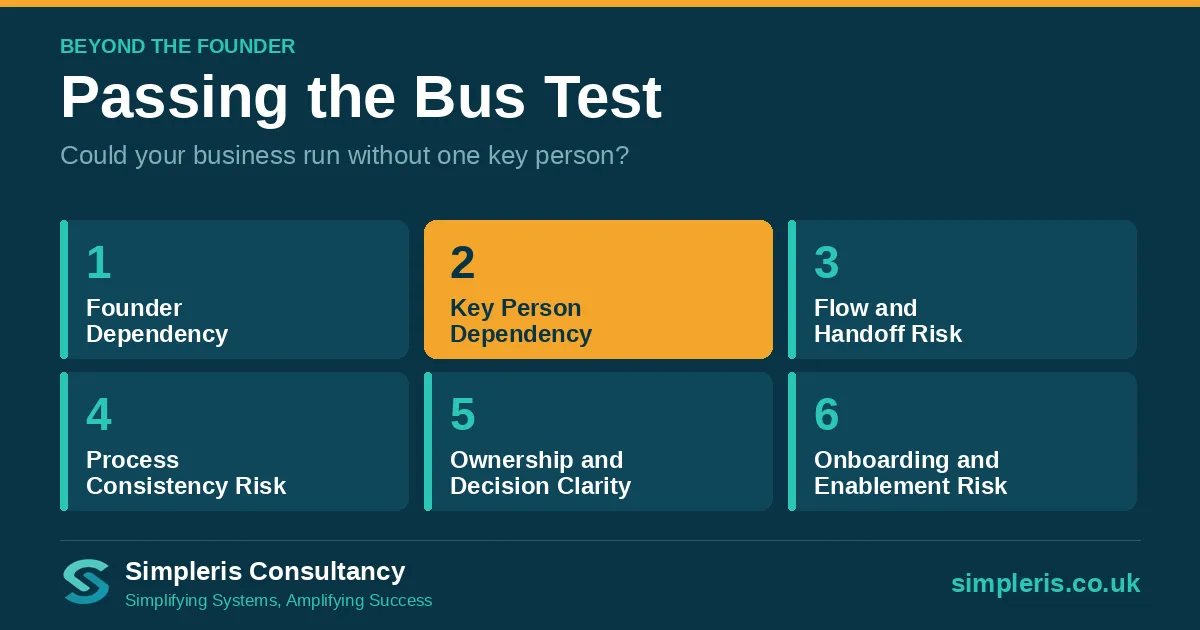
Key person dependency is critical knowledge, skill or relationships concentrated in one or two individuals who are not the founder. It is a close relative of Founder Dependency, the risk of the business depending on you, but it plays out differently because it hides in people you trust completely and rarely think to check.
The tell is simple: there is a name everyone says when a particular problem comes up. Not because that person is showing off, but because the knowledge genuinely lives nowhere else. Knowledge, relationships or skill sitting with one or two individuals, rather than in the business itself, is exactly what this domain describes.
It is worth being precise about the difference from Founder Dependency, because the fix is not the same. Founder Dependency is about decisions and judgement calls routing through you specifically. Key Person Dependency is about technical knowledge, supplier relationships or hands-on skill sitting with someone else entirely, often someone you trust completely and would never think to check up on. A business can reduce Founder Dependency to almost nothing and still be one resignation away from serious trouble, because the risk simply moved to a different head.
How Do I Identify Key Person Risk In My Business?
Run the Bus Test properly, not as a thought experiment but as an honest audit. Ask three questions about your most critical roles.
The silent holiday panic. When this person takes a week off, do the gears genuinely grind, or does work carry on at the same pace?
The left hand, right hand problem. Does information stop flowing predictably between teams the moment they are not the one carrying it between them?
The stalled decision. Does work wait on this person's judgement even when, on paper, someone else has the authority to decide?
If you answered yes to any of these for a role that is not yours, that role is carrying key person dependency. The more senior and specialised the role, the more likely the answer is yes, and the more expensive it is to keep ignoring.
Here is what it looks like in practice. A machine goes down mid-shift with an intermittent fault. The one person who has seen this exact fault before is not on site. Everyone else follows the standard troubleshooting steps, finds nothing, and the line sits idle for three hours until that person picks up their phone and talks a colleague through the fix they have done a dozen times before, off the top of their head. Nobody did anything wrong. The fault genuinely was unusual, and the standard steps genuinely did not cover it. The actual gap is that the one person who has seen it before never wrote down what they know, so the business has to wait for them to be reachable instead of consulting a record.
What Does It Cost When A Key Employee Leaves A Manufacturing Business?
The cost rarely shows up as a single number, which is part of why it gets underpriced. It shows up in three places.
Delivery slips first. Orders that person touched slow down or go wrong, often for weeks, while everyone else works out what they did not know they did not know. Margin follows. Rework, missed deadlines and rushed fixes all cost more than the same work done calmly the first time. And the business itself is worth less than it looks, because any buyer, investor, or your own future self weighing up a sale will discount for exactly this kind of concentration risk.
For a closer look at what this dependency costs even while the person is still there, not just after they leave, see The Operator Premium.
There is also a cost that lands before anyone resigns. A team that knows one person can hold the schedule hostage tends to route decisions through them by default, even small ones, because it is faster than working it out themselves. That habit quietly caps how much the rest of the team grows, whether or not the key person ever actually leaves.
How Do I Protect My Business From One Person Leaving And Taking Everything With Them?
Three steps, done properly, in this order.
Audit for the dependency. Identify the one or two people whose absence would genuinely break delivery, not just inconvenience it. Be specific about which part of what they do is the actual risk.
Capture the critical few decisions, not the whole job. You do not need to document everything they know. You need the handful of judgement calls that only they currently make.
Test it without them. Give someone else the reference and let them run with it while the key person is away. If it holds, the risk is genuinely reduced. If it does not, you have found the next gap to close.
This is not about hiring more people or building a manual nobody reads. It is about turning knowledge that exists in one head into something the business can rely on when that head is on holiday, off sick, or has moved on.
Start with whichever role would hurt most if it went unfilled for a month. Not the whole department, one role. Getting one critical few decisions written down and tested properly beats a half-finished attempt at documenting everything, and it gives you a template you can repeat for the next role once this one is done.
Why Does Cross-Training Usually Fail?
Because it copies the person instead of the knowledge. Shadowing moves attention, not judgement. A second person can watch the work being done for weeks and still miss the small decisions that make the first person good at it, because those decisions only surface when something goes wrong, and by then the expert has already handled it on instinct.
Worse, training a second person without capturing what they actually need to know just gives you two people carrying the same undocumented knowledge, which can quietly double the risk instead of halving it. For the full picture of why this trap catches so many manufacturers, and the smaller fix that actually works, see Why Cross-Training Fails (and the Smaller Thing That Works).
How Do I Reduce Key Person Dependency Without Cross-Training Everyone?
Skip the training programme and capture the critical few decisions instead. Sit with your key person for an hour, not a week. Ask what they would tell a replacement if they only had one page to write it on. Record the trigger, the call, and the exception for the two or three decisions that only they currently make.
That one page is worth more than a month of shadowing, because it is knowledge that no longer depends on a single head. It will not remove the dependency in an afternoon, but it starts moving it out of your key person's head and into the business, which is the only place it is genuinely safe.
None of this requires your key person to feel threatened or replaced. Framed well, it is the opposite: capturing their judgement is a recognition that what they know is valuable enough to protect, not evidence that the business is trying to make them dispensable. Most experienced operators, asked the right way, are glad to see their knowledge written down properly instead of relying on nobody ever asking the wrong question while they are away.
You cannot fix what you have not measured. Take the free Simpleris® Operational Risk Assessment to see how exposed your business is to Key Person Dependency, and which of the six domains to prioritise first.
Predictability is the only foundation for real scale. When the business does not depend on any single person, including you, you finally gain the freedom to lead the future rather than manage the day-to-day.
Related: Six Places Operational Risk Hides in a Growing Manufacturing Business
Related: Why Does My Business Stop When I Take a Day Off?
Related: Map What Your Operations Director Carries Before You Need To