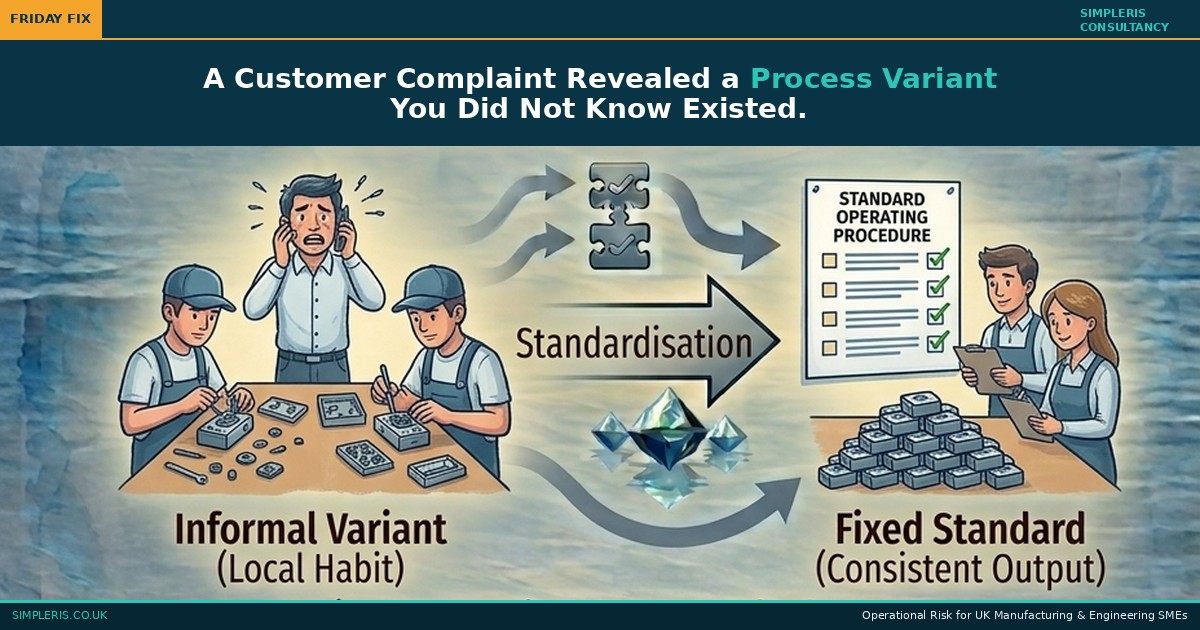
A Customer Complaint Revealed a Process Variant You Did Not Know Existed
A complaint came in. You investigated. The task had been done the way someone thought it should be done, not the way you expected. When you looked closer, you were not sure the standard was clear enough to tell the difference. The complaint is resolved. The variant is still running in the business, done the same way by the same person, and possibly by others you have not checked yet.
Pain: Customer complaint revealed a process variant you did not know existed.
Process variants do not start as deliberate departures from the standard. They start as gaps. When a written process is absent, incomplete, or stored somewhere the team cannot easily access during work, people fill the gap with their own judgement. The first time they encounter a task without a clear instruction, they improvise. If the improvisation produces an acceptable result, it becomes the habit. Over time, the habit becomes the way that person does the task. Nobody flags it because from the inside it looks like the job being done. The complaint is the first external signal that what is happening on the floor and what is expected by the customer are not the same thing.
This is process consistency risk. The problem is not the individual who did it differently. The problem is the standard that left room for a different interpretation. In a growing manufacturing or engineering business, standards that depend on people remembering the correct method -- rather than following a documented one -- create an invisible risk. The variant can run for months or years before a complaint, a return, or a quality audit reveals it. By then it may be embedded across several people and several shifts. The fix at the symptom level -- dealing with the complaint, having the conversation, reminding the team -- does not close the gap in the standard that allowed the variant to start in the first place.
Fix: Find the variant, fix the standard, retrain the team.
Three steps in sequence, each one necessary. Finding the variant means identifying not just what happened in this case but where the standard was unclear or absent, and what alternative version of the process has been running instead. This is not a disciplinary conversation; it is a process audit. Ask the person who did it to walk you through how they do the task. Compare it to what the written standard says, or to what you expected. The gap between those two things is the variant.
Fixing the standard means closing that gap with a specific, unambiguous instruction. Not a general principle. A specific step: what to do, in what order, to what specification, and how to check the output. One instruction that a person doing the task for the first time could follow without asking anyone. If the standard does not yet exist in writing, this is the moment to create it. The SYSTEMology method for process documentation starts exactly here: at the point of the discovered variant, not in a documentation sprint that gets planned and postponed. Retraining the team means actively communicating the change to everyone who does the task, not updating the document and assuming it will be read. Walk through the revised standard with the team. Make the change visible and explicit. A document that exists but has not been walked through does not change behaviour; a team briefing does. Process consistency risk is not resolved by writing better standards. It is resolved by writing them and then making sure the people who do the work know they have changed.
Has a customer complaint this quarter pointed to a process running differently than you thought it was?
Related: Same Defect, Same Line, Third Time This Year. The Fix Has Not Been Documented.
This post is part of the Friday Fix series, a weekly operational fix for UK manufacturing and engineering business owners.