Operational Risk is the Hidden Threat to Scaling Your Business
Most SMEs don’t struggle because of strategy.
They struggle because their operations can’t scale.
Start With an Operational Risk Assessment
Most founders focus on external risks.
Market shifts. Competitors. Economic pressure.
But the real risk is usually inside the business.
When your operation relies on people, memory, or inconsistency to function, growth becomes fragile.
That is operational risk.
This is what slows most scaling businesses down.
Used by growing businesses to identify hidden operational risks quickly
If any of this feels familiar, you are already experiencing operational risk
Work depends on specific people
You get pulled into decisions you should not need to make
The same task produces different outcomes
New hires take too long to get up to speed
Things work… until someone is unavailable
At first, this feels like growth.
Then it becomes friction.
Then it becomes a constraint.
Used by growing businesses to identify hidden operational risks quickly
This is what we typically see inside growing businesses
Founder still approving everything at 15–20 staff
New hires taking months to become effective
Work breaking between sales and delivery
Teams relying on “who knows how to do it”
Used by growing businesses to identify hidden operational risks quickly
What Operational Risk Actually Means
Operational risk is not a compliance term.
It is what happens when your business cannot run reliably without specific people.
It is the gap between:
👉 How your business should operate
👉 And how it actually operates day to day
When that gap grows, so does risk.
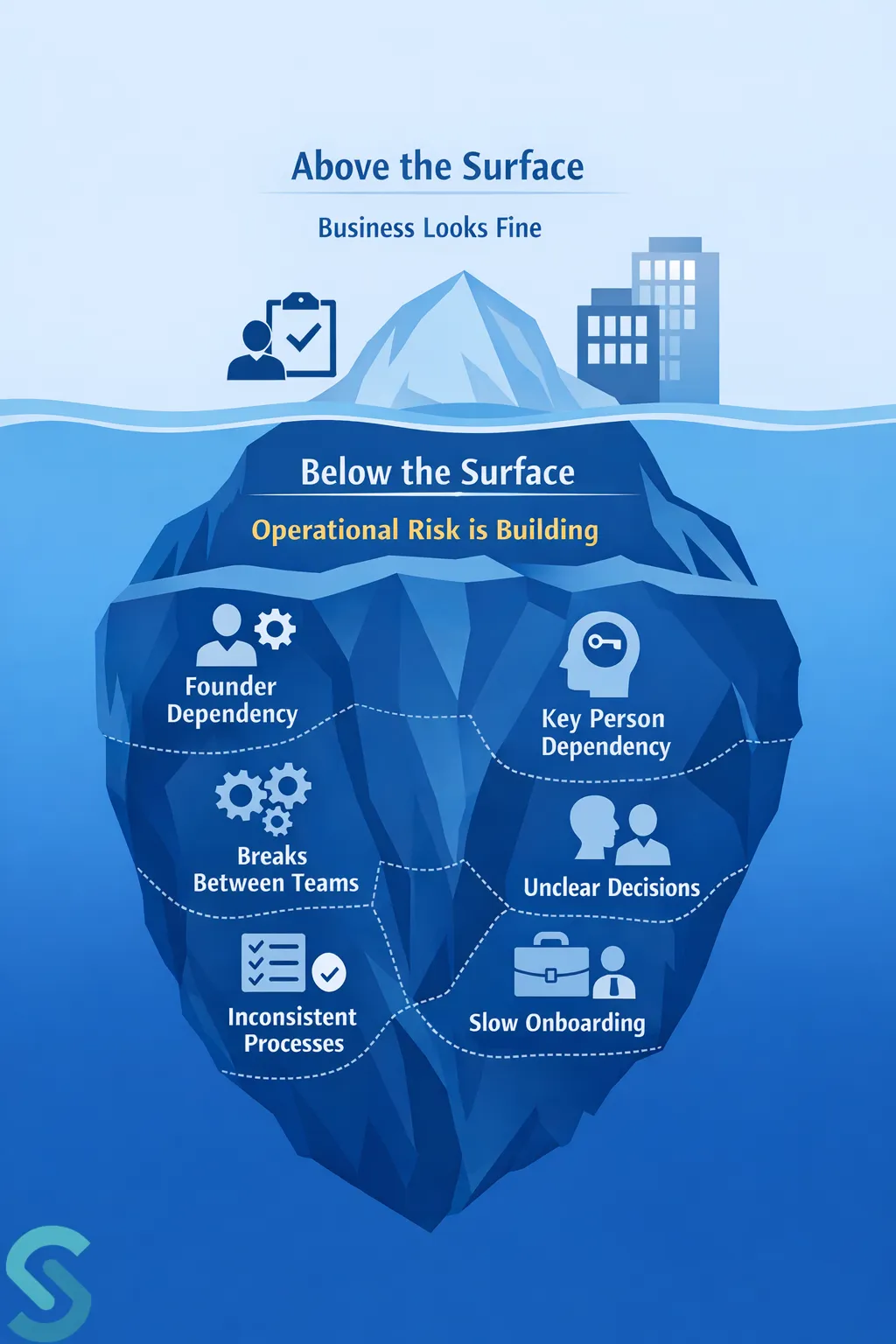
What You See vs What Actually Causes It
What you see:
Delays
Errors
Customer complaints
Firefighting
What actually causes it:
Founder dependency
Key person dependency
Inconsistent processes
Unclear ownership
Breaks between teams
Slow onboarding
Most businesses try to fix what is visible.
The real leverage is below the surface and
Very few address the structure causing it.
Used by growing businesses to identify hidden operational risks quickly
The 6 Pillars
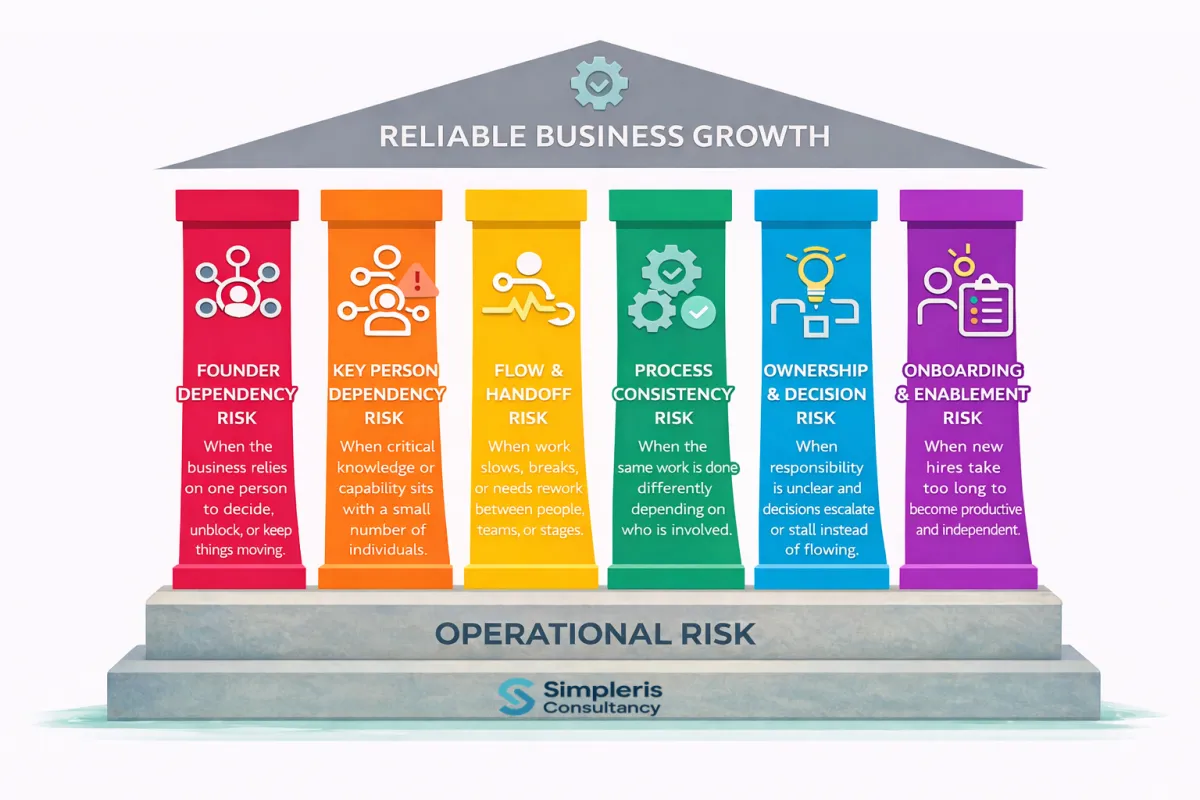
Founder Dependency
Everything routes through one person.
Decisions, approvals, and knowledge sit with the founder.
Key Person Dependency
Critical knowledge lives with individuals.
When they are unavailable, performance drops.
Breaks Between Teams
Work stalls or errors occur between handoffs.
Sales to delivery. Delivery to finance.
Unclear Ownership and Decisions
Work slows because ownership is unclear.
Decisions escalate when they should not.
Inconsistent Processes
The same work produces different results.
Quality and timelines vary.
Slow Onboarding and Enablement
New hires rely on people, not systems.
Time to effectiveness increases.
Most businesses don’t recognise this until it slows them down
By the time operational risk becomes visible:
Growth has already slowed
Teams are already stretched
Leaders are already overloaded
👉 Most founders don’t notice this until it starts slowing them down.
Why This Matters More Than Most Founders Realise
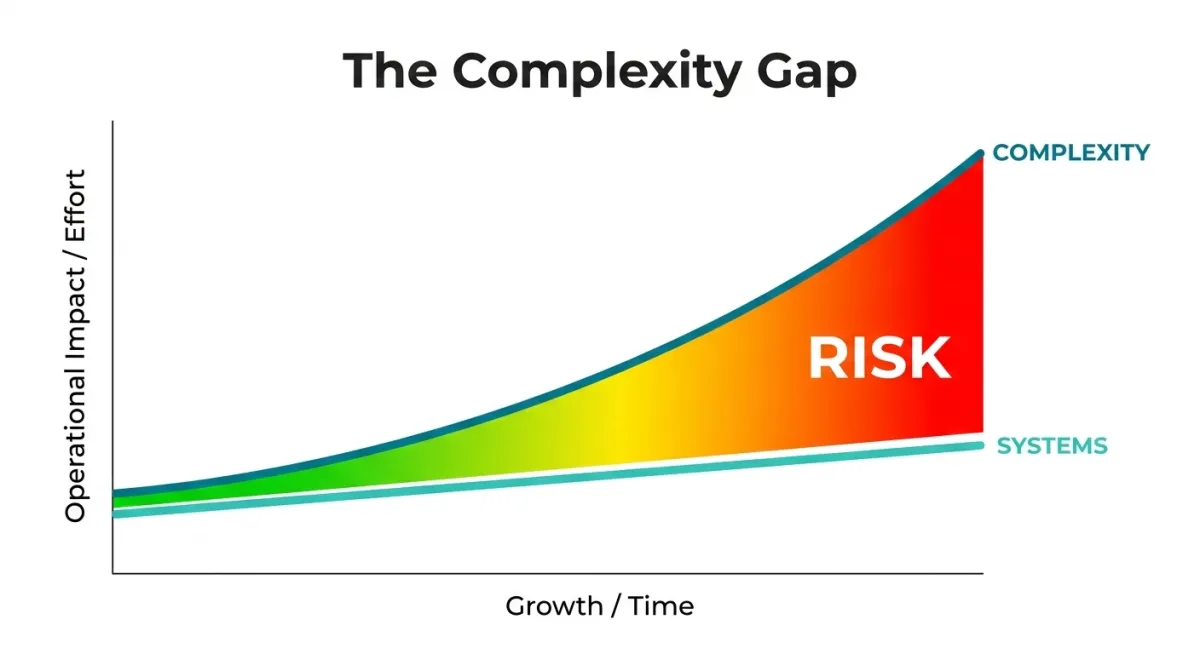
Operational risk does not stay hidden.
It compounds.
Growth becomes harder than it should be
Margins erode through inefficiency and rework
Leaders become bottlenecks
Teams rely on people instead of systems
At that point:
Growth doesn’t fail because of strategy.
It fails because the operation can’t support it.
Operational Risk Examples in Growing Businesses
A founder approving every decision for 20 staff
A project delayed because only one person knows the process
A business function delayed as a key person was on holiday
A new hire shadowing for months
A customer experience that varies depending on who delivers the product or service
Operational Risk FAQs
What is operational risk in a small business?
What is operational risk in a small business?
Operational risk in a small business is the risk created when the business cannot run reliably without specific people.
It shows up when work depends on memory, individual knowledge, or inconsistent ways of doing things.
For example:
- A founder needs to approve most decisions
- Only one person knows how key tasks are done
- The same process produces different results
At first, this feels manageable.
As the business grows, it becomes a constraint that slows progress and increases pressure on the team.
What causes operational risk when scaling?
What causes operational risk when scaling?
Operational risk increases when a business grows faster than its systems.
In the early stages, businesses rely on people to make things work.
As the team grows, that approach stops scaling.
Common causes include:
- Founder dependency as decisions don’t get delegated
- Key knowledge staying with individuals instead of the business
- Lack of clear, repeatable processes
- Unclear ownership of work and decisions
- Breaks between teams as handovers increase
- New hires relying on others instead of structured onboarding
Scaling exposes these gaps.
What worked at 5 people often breaks at 15 or 25.
How do I know if my business has operational risk?
How do I know if my business has operational risk?
Most businesses already have operational risk. The question is how visible it is.
You are likely experiencing it if:
- Work depends on specific people
- You are regularly pulled into decisions or problem-solving
- Delivery is inconsistent depending on who is involved
- New hires take a long time to become effective
- Work slows down when someone is unavailable
These are early signals.
Left unaddressed, they turn into bottlenecks, delays, and reduced performance.
How is this different from compliance risk?
How is this different from compliance risk?
Compliance risk is about external requirements.
It focuses on meeting regulations, standards, and legal obligations.
Operational risk is internal.
It is about how your business actually runs day to day.
You can be fully compliant and still have high operational risk if:
- Work is inconsistent
- Decisions are unclear
- Knowledge is not documented
- The business depends on specific individuals
Compliance protects the business externally.
Operational structure determines whether it can scale internally.
👉 Want to understand your operational risk?
How Simpleris Reduces Operational Risk
Most businesses don’t need more strategy.
They need their operation to work without them.
Using a structured, SYSTEMology-aligned approach, we:
Identify operational risk across your business
Capture the critical systems that drive results
Assign clear ownership
Train teams to follow consistent processes
Reduce reliance on individuals
The result:
A business that runs reliably without constant intervention.
Start Your Operational Risk Assessment
If your business is growing but feels harder to run than it should…
If progress depends on specific people…
If delivery is not as consistent as it needs to be…
Now is the right time to assess your operational risk.
Takes 3 minutes
No preparation needed
Immediate clarity on where your business is exposed
Not ready yet?
Explore how operational risk is reduced in practice:
or if you have a question, then Take a look at our FAQ
Operational risk reduction for scaling UK tech
and manufacturing businesses.
© 2025 Simpleris Consultancy Limited. All rights reserved.
Simpleris Consultancy Limited is a company registered in England and Wales with the company number 16693981.
VAT Registration GB501984787.