Why Does Work Keep Falling Through the Cracks Between My Teams?
It is Tuesday morning. A job left the floor on Friday, everything in order. Now it is sitting on a bench, untouched. Nobody lost it. Nobody refused to pick it up. It crossed a boundary between two people, and that is where it stopped.
Work disappears between departments like this more often than most owners realise, and the honest answer to "where did it go" is usually the same: nowhere dramatic. It just stopped moving, and nobody noticed until a customer asked.
What Does "Work Falling Through The Cracks" Actually Mean In Manufacturing?
Most managers look at a stalled job and ask a people question. Who dropped this? The honest version is usually different. Work does not disappear because of bad people. It disappears because the boundary between them has no specification.
Work slows or stalls at the points where it passes between people, not because anyone is careless, but because nobody has written down what a complete handoff looks like at that exact point. The end of a shift and the start of the next. The moment a job leaves the production floor and goes to despatch. The point where a customer query needs to move from the person who took the call to the person who can resolve it. Cracks are where ownership and handovers are unclear, and every one of those transitions is a place a crack can open.
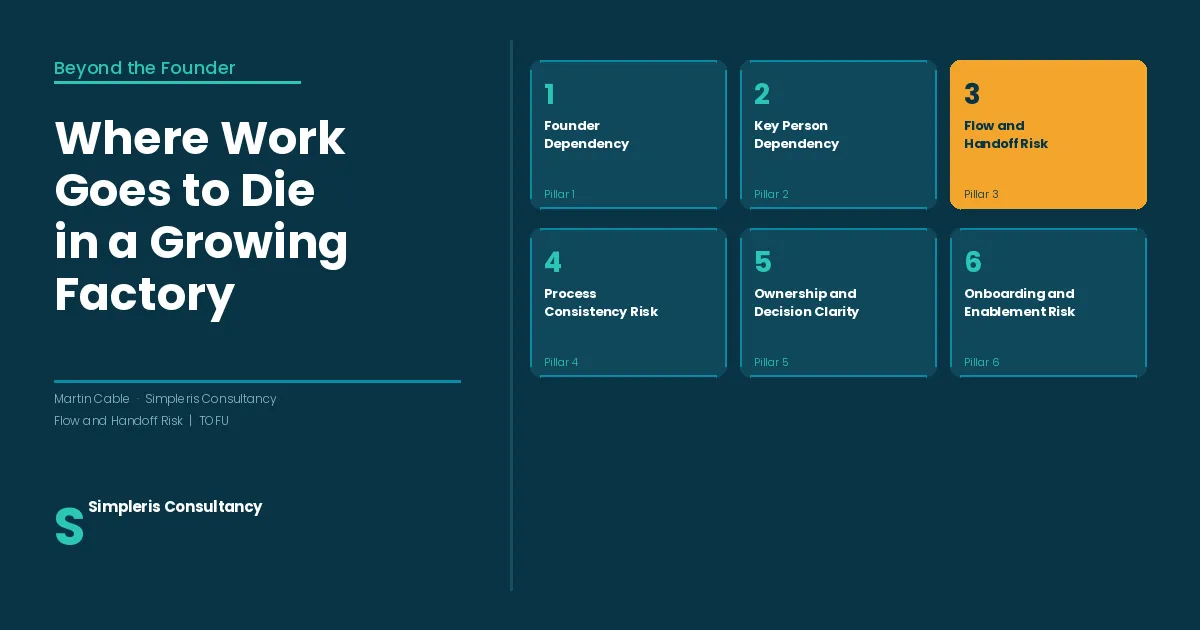
In a small business, these handoffs are held together by conversation, relationship and habit. People know what to do because they have done it together long enough. That is Flow and Handoff Risk, one of six domains where operational risk builds as a UK manufacturing business grows. It is one of the hardest to see, because it does not live with any one person. It lives in the space between them.
What Causes Production Bottlenecks In A Growing Manufacturing Business?
Growth is the cause, and it is a strange one, because growth looks like the opposite of a problem. Add people, add shifts, add departments, and the informal relationships that held the handoffs together stop scaling. The work still needs to move. The system for moving it has not kept up.
Here is what that looks like in practice. A quote goes out to a customer, and everyone assumes someone is chasing it. Sales assumes production is watching for the go-ahead. Production assumes sales will flag it when the customer confirms. Nobody owns the follow-up, so the quote goes in and no one chases it, until the customer chases you instead. Nobody did anything wrong. The handoff between sales and production simply never had an owner, so it defaulted to nobody.
The hardest handoffs to find are the ones that almost always work. Because when they fail, it looks like an exception rather than a gap in the design. That is why the same bottleneck can sit unnoticed for months and then suddenly cost you a customer.
How Do I Find Where Work Is Getting Stuck?
You do not need a full process audit to get a useful first read. Look for three signs, and they tend to appear together.
Work re-emerges at the wrong stage. A job turns up in despatch that should have gone through an inspection. A customer receives an answer based on information from three weeks ago. The work moved, but it skipped something in transit.
The same clarifications keep travelling upstream. If the same questions come back two or three times on the same job, the handoff specification is incomplete. The person receiving the work does not know what they have been given, so they ask.
Your most experienced people carry the bridges. If the informal system that holds your handoffs together depends on one or two individuals who understand both sides of the boundary, you have a knowledge dependency sitting on top of a process gap.
None of these are signs that your team is underperforming. They are signs that the boundary itself is underdefined. To find exactly where, walk a single job from start to finish and note every point it crosses a person, team or shift boundary. For each crossing, ask a blunt question: is there a written specification for what a complete handoff looks like here, or is it assumed?
What Is A Handoff Risk In Manufacturing?
A handoff risk is any point where work, information or responsibility moves from one person, team or shift to another without a defined standard for what "complete" means at that boundary. It is not the same risk as one person being overloaded, and it is not the same as a process being done inconsistently within a single role. It is specifically the gap between roles, where nobody has agreed what must travel with the work, who confirms it arrived, and what happens next.
This is why handoff risk is easy to miss in an org chart. Org charts show roles, not the boundaries between them, and the boundaries are exactly where this risk concentrates.
How Do I Fix Workflow Problems Without Hiring More People?
Most owners reach for headcount first. Hire another coordinator, another supervisor, another pair of hands to chase things that stall. It rarely works, because you keep hiring but it does not get faster. Adding people to an undefined boundary just adds another person who does not know what a complete handoff looks like there either.
The instinct when work stalls at a boundary is also to speak to the people around it. That usually produces short-term improvement and medium-term recurrence, because the boundary itself has not changed. The next person, the next shift, or the next team will produce the same stall at the same point.
The fix is in the design of the boundary, not the headcount either side of it. What information must travel with the work? Who confirms receipt? What triggers the next stage? Answer those three questions in writing for your highest-risk handoffs, and you fix the boundary once instead of managing around it every time it fails.
What Does A Well-Designed Handoff Look Like?
A well-designed handoff has four things a habit-based one does not.
A defined trigger. Everyone agrees on the exact moment work is ready to move, not a rough sense of "when it's done."
A specified package. What information, paperwork or context must travel with the work, written down once rather than remembered differently by each person.
A confirmed receipt. The receiving person or team acknowledges the handoff happened, so a stalled job is visible within hours, not discovered a week later.
A named owner on each side. Not "the team," a specific role responsible for sending it correctly and a specific role responsible for picking it up.
When those four things are answered in writing and made visible to everyone who crosses that boundary, the handoff becomes a standard. Standards can be maintained by anyone, not just the people who remember the original conversation. That is the difference between a process improvement and a people conversation.
At Simpleris, the starting point is usually a structured process mapping exercise that makes these boundaries visible, followed by a handoff design for the highest-risk transitions. Take the free Simpleris® Operational Risk Assessment to see how your business scores across all six domains, including Flow and Handoff Risk.
Related: Six Places Operational Risk Hides in a Growing Manufacturing Business
Related: Key Person Dependency in Manufacturing: How to Identify and Reduce It
Related: Why the Same Order Keeps Getting Stuck Between Sales and Production