Why Does It Take Six Months for a New Hire to Actually Be Useful?
You hired someone good. Four months in, they are still asking questions they should already know the answer to. Six months in, they are finally useful, and by then you have absorbed the cost of every mistake, every re-explained instruction, and every hour a senior person spent walking them through something that should have been written down.
This is not a story about one slow hire. Ask most manufacturing owners how long it takes a new starter to become genuinely independent, and the answer is somewhere between three and six months, regardless of how sharp the person is. That consistency is the giveaway. If the timeline is the same no matter who you hire, the problem is not the people. It is the process they are being onboarded into, or the lack of one.
Why Does It Take Six Months for a New Hire to Be Useful in Manufacturing?
Because nothing was written down for them to learn from. Without a documented process to follow, a new hire has one option: watch someone else and copy what they do. That works eventually, but it is slow, inconsistent, and entirely dependent on how good a teacher their shadow happens to be.
Six months is not a skill problem. It is the time it takes to learn an unwritten process by trial, error, and repetition instead of by instruction. A capable hire with a documented process can be productive in weeks. The same hire with no process takes months, not because they are slower to learn, but because there is nothing to learn from except other people's time.
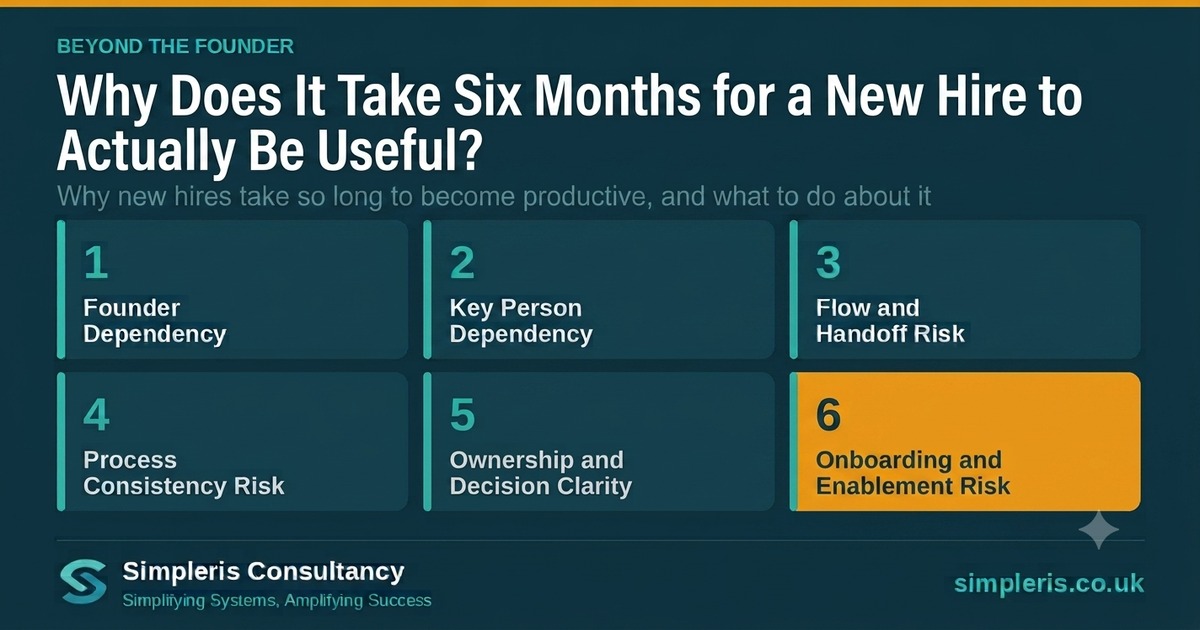
This is Onboarding and Enablement Risk: when new hires take too long to become productive and independent, and the business absorbs that drag every time it hires.
Why Are My New Hires Slow to Become Productive?
Because "keep up" is not a training plan. Most manufacturing businesses onboard the same way regardless of role: introduce the team, point at the machine or the desk, and let the new hire follow someone around until it clicks. Nobody plans this. It is just what happens when there is no alternative.
The result is a new hire who learns whatever their shadow happens to know, in whatever order it comes up, with no way to check whether they have covered everything. Two new hires doing the same job can come out the other side with two different sets of habits, because they shadowed two different people.
This connects directly to Process Consistency Risk: if the process itself was never documented, there is nothing consistent to onboard someone into in the first place. Fixing onboarding without fixing the underlying process just trains people faster into an inconsistent job.
What's Wrong With the "Shadow a Colleague" Approach to Onboarding?
It transfers habits, not standards. A new hire shadowing an experienced operator picks up whatever that operator actually does, including the shortcuts, the workarounds, and the small deviations that have crept in over time. None of that gets questioned, because it looks like "how it's done here."
Shadowing also has no defined endpoint. Nobody can say with confidence when a new hire is actually ready, because readiness was never defined. The shadow period just continues until someone decides the new hire seems competent, which is a judgement call, not a measurement.
The other cost is on your existing team. Every day a new hire shadows someone is a day that experienced person is not fully doing their own job. This is the "extended drag on existing team members" that shows up on every onboarding-related enquiry Simpleris sees: the new hire is slow, and the person training them is slower too, and both problems have the same root cause.
Add up enough of these hidden days across a growing team and shadowing stops being a training method and starts being a permanent tax on your most experienced people. The more you hire, the worse it gets, because your best operators spend more of their time re-teaching and less of it doing the work that made them your best operators in the first place.
How Do I Create an Onboarding Process for a Manufacturing Business?
Start from the process, not from the person. If a role's core tasks are already documented as SOPs, onboarding becomes teaching someone to follow a written standard, checking their work against it, and signing off each stage as they demonstrate it. If the role's tasks are not documented yet, onboarding cannot be fixed on its own. Document the process first, using the two-person capture method, then build the onboarding path on top of it.
A working onboarding process has three parts:
A written path, not a shadow. A short sequence of tasks the new hire works through in order, each one backed by a documented SOP they can refer back to without asking.
Checkpoints, not vibes. A defined point at each stage where someone signs off that the new hire has demonstrated the task correctly, not just watched it done.
A named owner. One person accountable for the new hire's progress through the path, so onboarding does not quietly become "whoever is free that day."
None of this needs to be elaborate. A single page per role, listing the core tasks in order with a checkbox next to each one, beats a lengthy induction manual nobody reads. Onboarding a role well only requires documenting the handful of tasks that actually matter for that job, not everything a senior person happens to know. That is the same 80/20 thinking behind minimum viable systems: a small number of the right systems, well used, do more for onboarding than a complete library nobody has time to read.
What Should Be in a Manufacturing Employee Onboarding Checklist?
A useful checklist covers four things, not just day-one admin:
Before day one: role SOPs identified and printed or shared, workstation or tools ready, a named buddy assigned who is not the busiest person on the shift.
Week one: the core SOPs for the role walked through and demonstrated once, safety and quality standards covered explicitly rather than assumed, first supervised attempt at each core task.
Weeks two to four: independent attempts at each task with sign-off against the SOP, questions logged rather than just answered and forgotten, so recurring gaps in the documentation surface.
Sign-off point: a specific, named moment where the new hire is confirmed as independently competent on the role's core tasks, not a vague sense that they have "settled in."
Most manufacturing onboarding checklists stop at week one, covering site induction and safety, then leave everything after that to shadowing. The gap between "inducted" and "independently productive" is exactly where the six-month drag happens, and it is the part almost nobody documents.
How Do I Measure Whether Onboarding Is Working?
Track time to independent sign-off, not time employed. If a role's onboarding path is genuinely working, you should be able to say, for any new hire, which core tasks they are signed off on and which they are not, at any point in their first three months.
Two numbers are worth watching over time. First, the average time from start date to full sign-off on a role's core tasks, which should shorten as your SOPs and onboarding path improve. Second, how often an experienced operator is pulled away from their own work to answer a question a new hire's checklist should already have covered. If that number stays high, the checklist is missing something, not the new hire.
If you cannot answer either question for your current new hires, that is the actual signal that onboarding is running on habit rather than on a system. Fixing that does not require an HR department or a learning management platform. It requires a written path for each role, a named owner, and a clear line for when "in training" becomes "signed off." Everything else follows from getting those three things in place.
You cannot fix what you have not measured. Take the free Simpleris® Operational Risk Assessment to see how Onboarding and Enablement Risk compares to the other five domains in your business, and which one is actually costing you the most.
If you want to see how we build the onboarding systems that make new hires productive faster, take a look at our operational design approach.
Related: Why Do We Keep Fixing the Same Problems? (A Process Consistency Guide for Manufacturers)
Related: Six Places Operational Risk Hides in a Growing Manufacturing Business
Related: Onboarding Is a System, Not a Hope