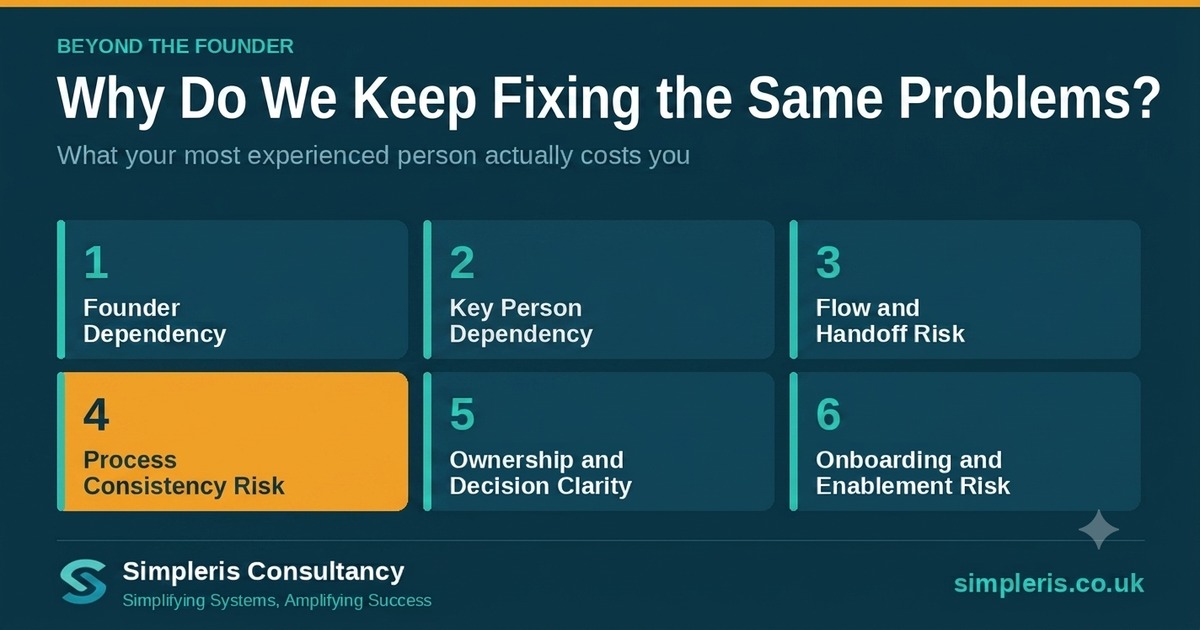
Why Do We Keep Fixing the Same Problems? (A Process Consistency Guide for Manufacturers)
It depends who does it. That is the honest answer to why the same defect keeps coming back, why lead times vary from job to job, and why two shifts working the same line get different results. Nobody wrote down the standard, so the standard is whoever happens to be on the floor that day.
This is Process Consistency Risk, and it is one of the more expensive domains of operational risk precisely because each individual incident looks small. A rework here, a repeated question there, a customer complaint that gets fixed and forgotten. None of it looks urgent. All of it adds up.
Most advice on this topic is written for offices, not factories. Generic guidance on "process documentation" talks about workflow software and approval chains. It rarely says anything useful about a goods-in inspection that depends on which shift is on, a setup sheet that only makes sense to the person who wrote it, or a defect that reappears every few months because the fix from last time was never written down anywhere. This is written specifically for that world: the shop floor, not the software.
What Is Process Consistency Risk In Manufacturing?
Process consistency risk is the same job producing different results depending on who does it, what shift is running, or how busy the floor is that day. It is not that your people are careless. It is that the standard exists as memory and habit rather than as something written down, so it drifts a little every time it passes from one person to the next.
The tell is simple: different teams working in different ways for what is supposed to be the same process. Lead times vary depending on who is involved, not because the work is genuinely different, but because each person is quietly running their own version of it.
This is a different risk from Key Person Dependency, where the danger is one person leaving. Process Consistency Risk is present even when nobody leaves. The cost is not a single dramatic gap. It is a slow, permanent tax on quality and speed, paid every single day the process runs without a written standard.
Here is what that tax looks like in practice. A goods-in inspection catches most defects, but not all of them, because one inspector checks five specific points from memory and another checks seven, learned from a different supervisor two years apart. Neither is wrong. Neither is following a written standard, because none exists. A defect that the seven-point check would have caught slips through on a day the five-point inspector is on shift, and it reaches a customer. Nobody failed. The standard itself never existed in a form both inspectors could follow the same way.
Why Do We Keep Fixing The Same Problems Over And Over Again?
Because the fix is happening at the symptom level, not the cause. A defect gets caught, corrected, and the job moves on. Nobody asks why it happened, because the immediate pressure is to ship the order, not to interrogate the process. Three months later, the same defect appears again, and it gets fixed the same way, because the underlying gap was never closed.
Errors that repeat despite fixing them are not a sign your team is careless. They are a sign the correction lives in one person's memory rather than in a written standard everyone can follow. Every time it recurs, someone re-solves a problem that was already solved once, quietly, and then forgotten.
The pattern breaks only when a fix gets written down at the point it is made, not just applied and moved past. That single habit, catching the correction in writing the first time, is worth more than any amount of retraining after the fact.
This is also why retraining rarely sticks on its own. Retraining hands someone the same undocumented process again, told slightly differently by whoever is doing the training that day. Without a written reference to check against, the next person's version drifts just as far from the original as the last one did. The fix is not more training. It is a standard that exists independently of whoever happens to be explaining it.
Why Is The Quality Of Our Work Different Depending On Who Does It?
Because the process depends on the operator's judgement and experience rather than on a defined standard. Your most experienced people have absorbed years of small decisions: which setting to nudge, which supplier to trust, which shortcut is safe and which one is not. None of that is written anywhere. It lives entirely in their heads.
A newer or less experienced person doing the same job does not have access to that judgement, so they either guess, ask, or fall back to the literal instructions, which were never detailed enough to cover the situations that actually come up. The quality gap you are seeing is not a training gap. It is the gap between documented knowledge and undocumented judgement, and no amount of supervision closes it permanently. Only writing the judgement down does.
There is also a quieter cost here that rarely gets named. When quality genuinely does depend on who does the work, your best people become harder to schedule around, not easier. Every shift pattern, every holiday, every attempt to move someone into a new role has to account for who is "safe" to put on a given job. That scheduling tax compounds the moment quality stops depending on a specific individual and starts depending on a written standard instead.
How Do I Create Standard Operating Procedures For A Manufacturing Business?
Start narrower than you think you need to. The instinct is to document everything at once, which is exactly how most SOP projects stall before they finish.
A useful starting method, drawn from the SYSTEMology methodology (the systemisation approach Martin is a Certified SYSTEMologist in), works in three steps.
Map the critical few processes first, not all of them. Every manufacturing business runs on a small number of processes that actually carry the business, usually somewhere between seven and twelve, covering the journey from a new enquiry through to delivery and repeat business. Start there, not with every task in the building.
Identify who already does each process well. Not the manager, not you. The person who currently does the task to a high standard, day in and day out. They are your knowledgeable worker, and they are the only reliable source for what the standard should actually say.
Capture the process from the person doing it, not from a whiteboard exercise. Documentation written from memory in a meeting room misses exactly the judgement calls that make the process work. Documentation captured from the person doing the job, while they are doing it, catches them.
This is not a compliance exercise. It is a practical transfer of what your best people already know into a form the rest of the business can use.
Picking the critical few is easier than it sounds. Walk the journey a typical order takes, from the moment a customer enquires to the moment they are invoiced and might come back for more. Every stage that journey passes through is a candidate. Most manufacturers find the list lands somewhere between seven and twelve processes once they map it honestly, not the fifty or sixty individual tasks it feels like from the inside. That shorter list is what you actually need to document first.
How Do I Document A Process That Exists Only In Someone's Head?
Make it a two-person job, not a writing exercise. One person does the task exactly as they normally would, narrating the small decisions as they go. A second person watches and writes down what they see and hear, especially the parts the doer treats as obvious.
That second part matters more than it sounds. The doer will skip the details that feel too basic to mention, because to them they are basic. Those are usually the exact details a less experienced person is missing. Ask a simple question at each decision point: why did you just do that, and what would happen if you had not?
Write the answer as a short reference, not a manual. The trigger for the step, the decision itself, and the exception that occasionally applies. One page for a process, not twelve. A rough, used standard that captures the real judgement beats a polished document that sits unread because it took three weeks to produce and nobody has time to check it against reality.
What's The Minimum Viable SOP For A Small Manufacturer?
The smallest version that actually gets followed. This idea, Minimum Viable Systems, is deliberately the opposite of a compliance manual: rough but used beats perfect but unwritten.
A minimum viable SOP for most manufacturing processes fits on a single page and answers three questions plainly:
What triggers this process, and what does "done" look like? The clear start and end point, so anyone can tell if the job is on track without asking.
What are the two or three decisions that actually require judgement? Not every step, just the ones where someone currently has to think, guess, or ask. Those are the only parts worth capturing in detail.
What is the most common way this goes wrong, and what do you do about it? The one exception that comes up often enough to be worth writing down, rather than every theoretical edge case.
If a process is genuinely followed by everyone who touches it, a one-page reference has done its job. You can always add detail later, once the habit of following a written standard exists. You cannot skip straight to a perfect manual and expect a team with no habit of using documentation to suddenly start.
Take the goods-in inspection example from earlier. A minimum viable version does not need forty checkpoints and a sign-off matrix. It needs the honest seven or eight points that actually catch the defects you see repeatedly, written down once, agreed by whoever currently does the check well, and put where the next inspector on shift can actually see it. That is a smaller ask than it sounds, and it is the difference between two inspectors quietly running different standards and one written standard both of them follow.
Start With The Process Costing You Most
You do not need to systemise the whole business this quarter. Pick the one process where inconsistency is costing you the most right now, whether that shows up as rework, customer complaints, or the same question landing on your desk every week. Document that one properly, using the method above, and test whether it actually gets followed without you chasing it.
Test it the same way you would test any other fix for operational risk: step back and see if it holds. If the standard gets followed without you reminding anyone, the risk in that one process is genuinely reduced. If it quietly stops being used within a few weeks, that is useful information too. It usually means the standard was written from a meeting room rather than captured from the person actually doing the job, and it is worth going back to whoever does that work best and starting again from their version of it.
Most owners already know, roughly, where this is worst. It is the process behind the complaint that keeps recurring, or the one new hires struggle with longest, or the one your most senior person quietly compensates for without anyone asking them to. Start there rather than waiting for a formal audit to confirm what you already suspect.
Related: Six Places Operational Risk Hides in a Growing Manufacturing Business
Related: Undefined Processes Fail People, Not the Other Way Around