Write the Steps. Remove the Friction. Free the Team.
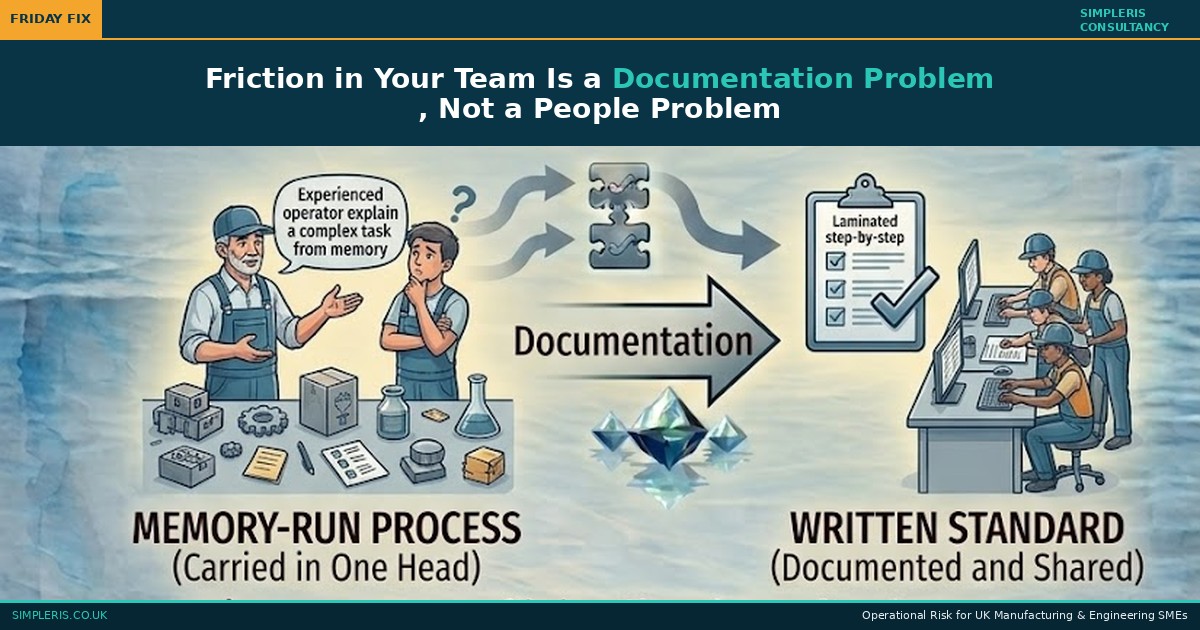
There is a task your team does every week. It takes longer than it should, produces small errors that someone has to correct, and occasionally goes sideways when the person who normally handles it is off sick or on leave. When you ask how it is supposed to be done, the answer is a referral to whoever has done it longest. That person explains it from memory, slightly differently each time they explain it. The task has never been written down. It has been handed over from person to person through observation. Every handover introduced a small change. Nobody noticed the drift until the friction became unavoidable.
Pain: Your team slows down on a process nobody has written down.
This is not a training problem and it is not a staffing problem. The problem is that the process was never codified. In most small manufacturing and engineering businesses, a large proportion of how work actually gets done is stored in the heads of experienced employees rather than in any document. This happens naturally and without anyone intending it. The person who is best at a task is also usually the person who is too busy to document it. The knowledge accumulates through observation and practice, and because the team is small enough that the expert is usually available when needed, the absence of documentation stays invisible. It only becomes visible when the expert is unavailable, when a new person tries to follow the task without guidance, or when the informal handover produces an error that was never there before.
The operational cost is higher than it appears. When a process lives in one person's head, every other team member who needs to do it must either wait for that person, approximate the correct approach from partial information, or ask the same questions repeatedly. Each of those options consumes time, creates inconsistency, and increases the chance of an error that reaches the customer. This is process consistency risk building quietly in the background. The experienced employee is not the liability. The undocumented process is. When the documentation exists, the expert's knowledge becomes a business asset rather than a personal one. It can be tested, refined, and used by the entire team regardless of who is present on any given day.
The cost accumulates in ways that rarely appear on a report. Time lost to repeated questions does not show up as a line item. Rework that the experienced operator quietly corrects before it reaches the customer is invisible to anyone reviewing output quality. The new starter who takes twelve weeks to reach full confidence rather than six represents a cost that nobody calculates. Each of these losses is small on any given day, and that is precisely why undocumented processes persist. The threshold for writing something down feels higher than the threshold for absorbing the daily friction of not having it written. But the undocumented process is not free. It is just costly in a way that is spread across the team in small enough amounts to avoid triggering action until the friction becomes impossible to ignore.
Fix: Document one friction point this week and make it the new standard.
Identify the one process in your business that currently causes the most friction for the most people. Not the most technically complex process. Not the one with the most steps. The one that generates the most unnecessary slow-down, the most repeated questions, and the most variable output. Ask the person who handles it most reliably to write down the steps while they are doing it, capturing what they actually do, not what the theory says should happen. That draft is the starting point. Test it with a second person: can they follow it from start to finish without asking for guidance? Every step that requires a question to complete is a gap in the document. Close the gaps, and add the result to your operating system in a place the whole team can find it.
The friction does not just reduce. It stops accumulating. The question your best operator used to answer ten times a week gets answered once in the document and stops generating questions. The inconsistency that used to produce rework gets replaced by a consistent output the team can rely on. The new starter who previously took six weeks to reach full confidence can follow the document from their first week. None of this requires a significant investment of time or money. It requires one person to observe and write down one process this week. The compounding effect of a written standard is slower to appear than dramatic intervention, and considerably more durable than supervision.
What part of your workflow caused friction this week?
This post is part of the Friday Fix series, a weekly operational fix for UK manufacturing and engineering business owners.