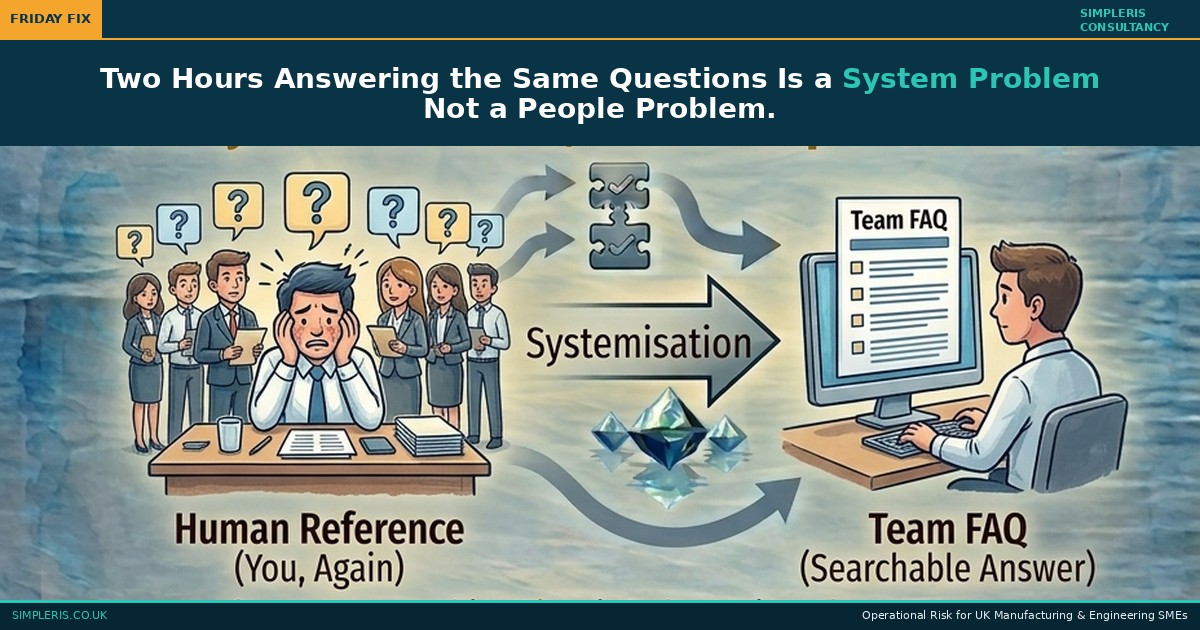
Two Hours Answering the Same Questions Is a System Problem, Not a People Problem
Three separate team members came to you yesterday with questions. Different situations, different contexts, same pattern: the answer was with you. You gave it each time and moved on. By the end of the day you had spent close to two hours in conversations that produced nothing except the same knowledge you already had, transferred once more to people who may need to ask again next month.
Pain: Spent two hours yesterday answering questions you have answered before.
This is not a sign that your team is underperforming. It is a sign that the business has no accessible alternative to you. When there is nowhere else to look, people come to the person who knows. In most manufacturing and engineering businesses at this stage of growth, that person is the owner. The knowledge sits in your head, built up through years of decisions, exceptions, and adjustments, and it has never been written down because you were always available to provide it directly.
The problem is not that the knowledge exists. The problem is that it is centralised in one place. Every question that reaches you instead of a document is founder dependency made visible. It scales in the wrong direction. As the business grows, the team grows, and the volume of questions grows with it. Your available time does not. What feels manageable now -- a couple of hours across the week -- becomes the dominant drain on your working day within a year or two. The team becomes slower because the bottleneck is you, and you become unable to focus on the work that genuinely needs your attention because the operational questions never stop arriving.
There is a second cost that is less obvious. When the team knows the answer is always available from you, they stop building the habit of looking for it themselves. The dependency becomes cultural. New people join and learn immediately that the way to find out how something works is to ask the founder. The pattern embeds. Writing a FAQ does not just reduce the number of questions you receive; it begins to shift the expectation of where answers live.
Fix: Build a 10-question FAQ for the team and put it in one place.
Start with this week. Which questions have come to you more than once in the last month? Write down the ten most common. For each one, write the answer in the same plain language you would use if you were explaining it in the room. Two to four sentences is enough for most. The goal is not a comprehensive knowledge base. It is an accessible first answer that the team can find without asking you.
The location matters as much as the content. One URL, shared with the whole team, linked from wherever the question is most likely to arise -- the start of a job, a handover point, the shared folder for a particular customer or product line. The SYSTEMology approach to this is straightforward: document at the point of the question, not in a separate documentation project that never gets started. The next time a question reaches you that belongs in a FAQ, answer it and then add it to the document before you move on. Over time, the list grows from real questions in the sequence the team actually encounters them. Teams that build this habit consistently find that the volume of repeated questions falls within a few weeks. The knowledge stops living only in your head and starts living in the business where the team can reach it.
What question did someone ask you this week that you have already answered at least once before?
This post is part of the Friday Fix series, a weekly operational fix for UK manufacturing and engineering business owners.