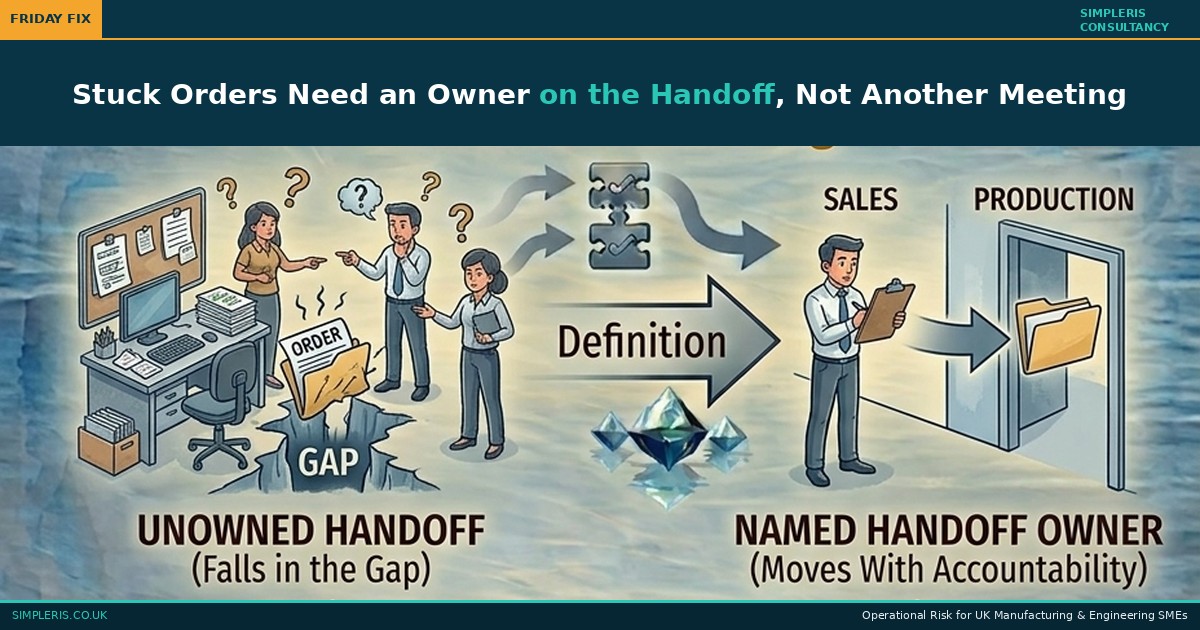
Stuck Orders Need an Owner on the Handoff, Not Another Meeting
The order was confirmed last Tuesday. Sales logged it, sent the usual email, and moved on. Production had not received a materials list. Nobody had flagged the non-standard lead time the customer had requested. When the order finally surfaced on the production schedule, it was already late. Both teams had followed their process correctly. The gap was between the processes, in a space that neither team owned.
Pain: Same order keeps getting stuck between sales and production.
This is not a communication problem. It is a structural problem with a communication symptom. The sales process has a clear endpoint: the order is logged, the confirmation is sent. The production process has a clear starting point: the job appears on the schedule with materials confirmed. But the space between those two events is where assumptions live. Sales assumes production has what they need. Production assumes sales would flag anything non-standard. Both assumptions are reasonable, and both are wrong in this case, and the customer experiences the result without understanding why. Flow and handoff risk lives exactly in this gap. It does not require anyone to fail at their own job. It requires only that two processes meet in an unowned space, and that nothing in either process makes the transition between them explicit.
The volume of orders that pass through without incident masks the problem. Most orders are standard. The standard ones carry enough information by default. They go through without friction, and the informal assumption that the system works gets reinforced. The non-standard order is the test case, and it fails not because anyone handled it differently, but because the default information set is not enough for it and there is no mechanism to catch the gap. The next similar order fails for the same reason, because the gap that caused the first delay was never closed. Both teams got on with their work, the order was rescued by escalation, and the gap reset for the next one.
The instinctive response is to add a meeting. A weekly sales-to-production handover that surfaces issues before they become delays. Meetings can work, but they do not close the underlying gap. They compensate for it, on the days they happen, for the orders that make the agenda. The order that slips through at 4.30 on a Friday does so regardless of how well the Monday meeting ran. Over time, the meeting becomes the system, and the gap beneath it stays open and invisible until the next failure. Enough failures and the meeting gets lengthened or made more frequent, and the cost of carrying the unowned handoff grows without the cause ever being addressed.
Fix: Add a single owner to the handoff, not another meeting.
Identify the specific moment where the order passes from sales to production. Define what information must travel with it and what state it must be in for production to proceed without guessing. This means writing it down: the required fields, the confirmation steps, the check that the handoff is complete before the order moves forward. Not as a policy document. As a working checklist that the person responsible for the handoff can run through in two minutes before releasing the order to production. If a non-standard requirement exists, it surfaces at the handoff point rather than at the point in production where it becomes a delay.
Then assign one named person as the owner of that transition. A defined handoff point with a named owner stops orders from disappearing between two functioning teams. The owner does not do all the work. They own the gap: the person responsible for confirming the handoff is complete and that production has what it needs before the job moves forward. One person. One accountable point. When the handoff fails, there is no ambiguity about where the breakdown happened. When it works, the order moves without needing to be rescued. The meeting can go. The owner stays. And the orders that used to get stuck start moving.
Which handoff in your business keeps needing a meeting to rescue it?
This post is part of the Friday Fix series, a weekly operational fix for UK manufacturing and engineering business owners.