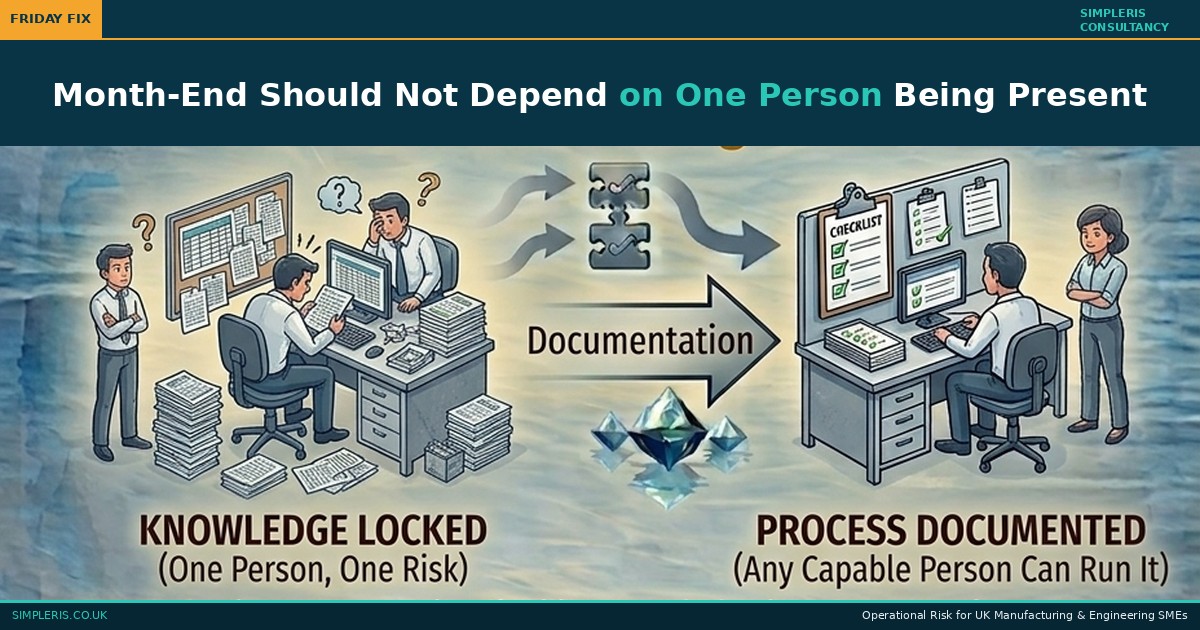
Month-End Should Not Depend on One Person Being Present
Month-end approaches. The finance lead is on annual leave, or has resigned with two weeks' notice, or has had to take emergency time off. The knowledge of how to run month-end sits entirely with them. The sequence of reconciliations, the order of entries, the specific checks that have to clear before the numbers are right: it exists in one person's head and nowhere accessible to anyone else. The month closes late, or incorrectly, or with someone guessing at the steps under pressure.
Pain: Finance lead is the only person who can run month-end.
This is not a performance problem. It is a structural one. The business has accumulated a critical process that only one person can run, and that dependency is invisible until it fails. Because the finance lead is always there, always does it correctly, and never raises it as an issue, the risk never surfaces as a problem in the normal run of things. It surfaces as a crisis: month-end cannot close, or someone less experienced runs it under pressure and gets it wrong. Key Person Dependency hides behind reliability. The person is reliable. The structure around them is fragile. And unlike a machine that shows signs of wear, a human dependency gives no warning signal until the person is absent.
The dependency also limits the person who holds it. The finance lead cannot take leave without creating anxiety at board level. They cannot step into a more strategic role without leaving a vacuum in the month-end process. They cannot be promoted without the business first solving a documentation problem it has been deferring since they took the role. The knowledge they hold is locked inside their daily work rather than accessible to the business as a standing asset. Their expertise is not the risk. The absence of a documented process around it is. A business that cannot operate its core financial close without one specific person present is not running a finance function. It is running a finance dependency.
The pattern tends to persist because nothing goes wrong while the person is present and performing. Month-end closes correctly, the numbers are right, and the dependency is invisible. The cost of not documenting it is invisible on all the normal months, which is most months. It only surfaces during a disruption, at which point the response is reactive: the person is called while on leave, someone senior steps in and muddles through, or the month closes late and nobody quite knows why. The disruption passes. The finance lead returns. The dependency resets. The underlying gap stays open and the business moves on to the next month without addressing the structural weakness that the disruption exposed.
Fix: Document the steps and have someone else dry-run it this month.
Ask the finance lead to document the month-end process in full: the sequence, the tools, the specific checks, the common failure points and what each one means, the judgements that get made at the close. Not a summary. A step-by-step walkthrough that someone unfamiliar with the process could follow without needing to ask questions mid-run. This means capturing not just what to do but why each step matters, what a correct result looks like, and what to do when a check does not clear. The goal is to convert tacit knowledge into a document that survives the finance lead's absence.
Then have a second person dry-run it this month, working through the process alongside the finance lead with the document open. Every step that requires a question is a gap in the document. Close it. The goal is not to replace the finance lead. It is to convert their knowledge from a personal asset into a business asset. One documented, tested month-end process means the business can continue operating if the person is unavailable, can promote them without leaving a gap, and can audit the process against a written standard rather than a person's recall. The knowledge still belongs to them. The dependency no longer belongs to the business. That is what makes it an asset rather than a risk.
Which month-end or quarter-end process would stop if your key person was unavailable for three weeks?
This post is part of the Friday Fix series, a weekly operational fix for UK manufacturing and engineering business owners.