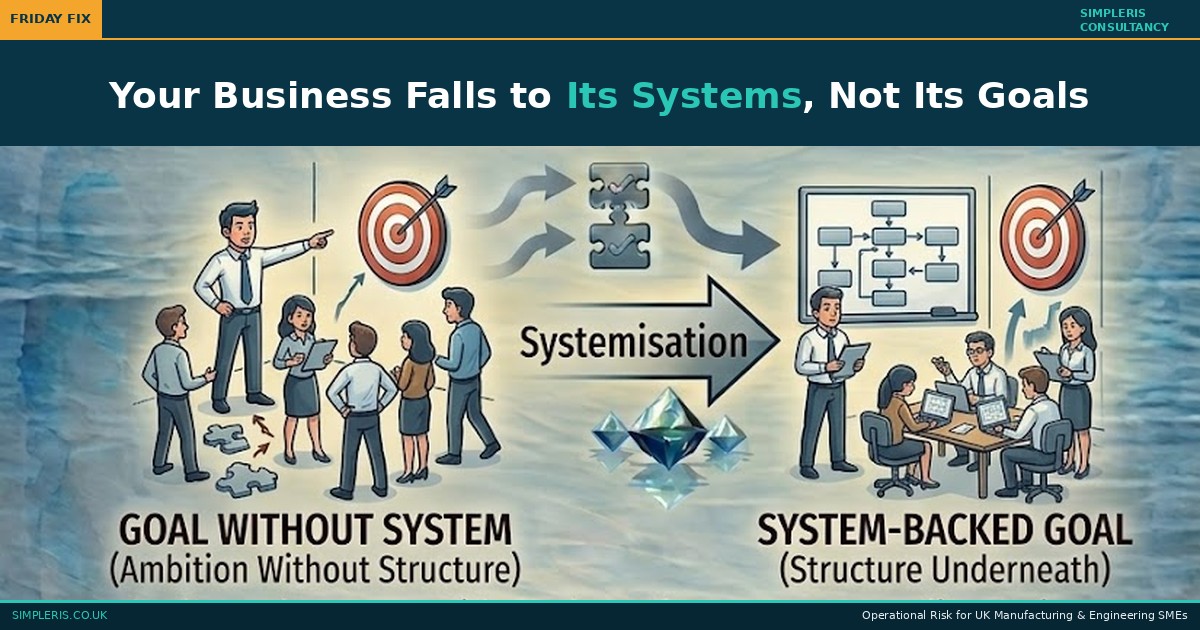
Your Business Does Not Rise to Its Goals. It Falls to Its Systems.
You set a target for Q3. Everyone in the room agreed it was achievable. Three months later, the number is not close to where it needs to be. When you ask what happened, the team gives you reasons: a busy period, some unexpected customer issues, a couple of jobs that ran over. The reasons are real. But they are not the root cause. The goal was clear. The system underneath it was not.
Pain: The goal is clear. The system underneath it is not.
Business goals do not fail because the people meant to reach them are not trying. They fail because goals describe a destination without specifying the mechanism. A revenue target does not tell anyone how orders should be processed, how the team should be organised, or which decisions need to be made by whom and when. Most small manufacturing and engineering businesses carry these mechanisms informally: the experienced team members who know how the work gets done, the routines that developed over years of practice, the habits that produce output without anyone having to specify them. When those informal mechanisms are reliable enough, the target gets reached. When they are not, the target slips while everyone looks busy and no one is sure why.
The harder truth is that informal mechanisms tend to fail under exactly the conditions that a growing business creates. When volume increases, new people join, or the product range expands, the informal system that worked at smaller scale shows its gaps. Quality becomes variable. Deadlines start slipping. Customers notice before you do. The instinctive response is to add oversight: more meetings, more check-ins, more direct involvement from the people at the top. Oversight can paper over the gap temporarily, but it does not close it. The underlying cause is process consistency risk: the absence of a documented, reliable mechanism for delivering on the goal. When the oversight lifts, the gaps return.
The cost compounds quietly. A quarter that should have hit a target closes ten percent short. The reasons offered are reasonable: staffing pressure, a difficult client, jobs that ran longer than expected. But the same quarter runs the following year and produces the same shortfall with a different set of reasons. The underlying mechanism has not changed, so the result cannot change either. This is the characteristic pattern of a goal without a supporting system: variable surface explanations for a consistent structural gap. Each quarter begins with the same informal assumptions as the last, and those assumptions produce the same friction, the same dropped handoffs, the same decisions that nobody was quite sure who should make. The target moves annually. The gap beneath it stays fixed.
Fix: Identify one goal that keeps slipping and document the system it needs.
Take the goal that has missed its target most consistently over the past two or three quarters. Not the one with the most external explanations, but the one where internal execution is the most plausible factor. Work backwards from the goal: what would need to happen reliably, in the right order, by the right people, for this goal to be achieved on a normal quarter? Document that sequence. You do not need a complete, polished system on day one. You need a visible, consistent mechanism that the team can follow, consciously deviate from when circumstances require it, and improve as they learn. The documented process is the starting point. Without it, every quarter begins from the same informal assumptions that produced the same result last time.
The payoff is not only about hitting the target once. When the mechanism is documented and visible, you can see where it breaks. You can identify the step that most often stalls, the handoff that most often drops, the decision that most often gets deferred because nobody was sure who should make it. You can fix the system rather than managing the symptoms. Goals do not fail because the people assigned to them lack ambition or effort. They fail because the system that should carry them was never built. A single documented mechanism for one slipping goal is worth more than a quarterly target-setting session without it.
Which goal felt harder to reach this week because of weak systems?
This post is part of the Friday Fix series, a weekly operational fix for UK manufacturing and engineering business owners.