When the Exception Becomes the Rule, One of Them Needs to Change
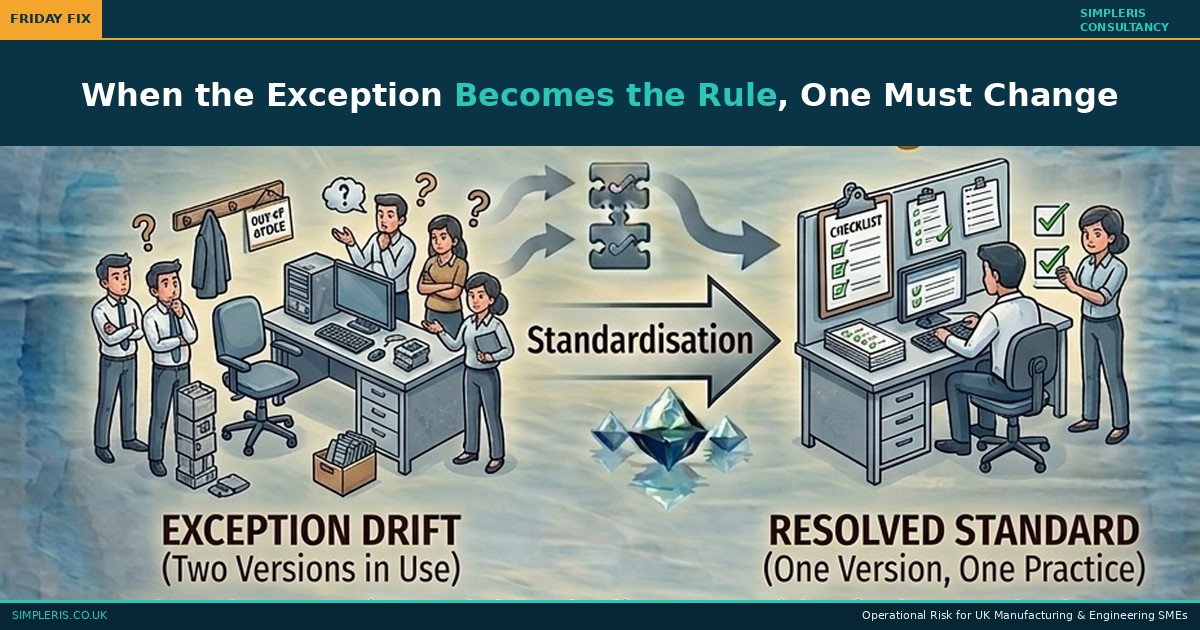
A customer needed something done differently, just once. You agreed, it was handled, and the outcome was good. Six months later, the team is doing it that way for most jobs. Nobody made that decision. It drifted into practice because it worked and nobody stopped it. The original procedure still says one thing. The team now does another. Two versions of the same process are running simultaneously, and neither is the documented standard.
Pain: A small exception became how you always do it.
Exception drift is one of the quietest forms of process inconsistency. Unlike a deliberate change, it leaves no record. No one decided to change the process. The exception was appropriate in the original case and worked well enough in enough subsequent cases that the team adopted it informally. New starters learn the exception from the people who train them, because the exception is what the team actually does from day to day. When asked about the discrepancy, the answer is “oh, we changed that a while back” without anyone being sure when, why, or whether the change was ever a deliberate decision. Process consistency risk widens wherever the working standard and the documented standard diverge. Exception drift widens that gap gradually and without a record, until an audit, a new requirement, or a quality failure makes the gap visible.
The cost is not only the gap between document and practice. It is the inconsistency between team members. Some follow the exception. Some do not know about it. Others have a slightly different version of it. The same task produces different outputs depending on who handles it and when they joined. Nobody is non-compliant, because there is nothing clear enough to comply with. The exception has become practice without becoming the standard, and the team has no authoritative reference to resolve the inconsistency. When a quality failure occurs, the investigation produces three different accounts of how the task should have been done. Nobody is lying. They are each reporting a different version of a process that was never formally reconciled.
The pattern is self-reinforcing because the exception continues to produce acceptable output most of the time. The cases where it fails are handled individually, attributed to variation in the work or in the people, and the underlying inconsistency stays untouched. The documented procedure ages without being updated. The informal practice spreads without being formalised. The gap between them grows. Over time, the business operates with a shadow standard that most experienced people follow and newer people try to piece together from observation. What should be a single clear procedure becomes a body of tribal knowledge that new starters can never quite fully access and managers can never quite fully audit.
Fix: Decide whether it is the exception or the new rule, then update one of them.
Find the process where the documented procedure and the actual practice have diverged. Do not assume the documented version is right. It may be that the exception genuinely improved the outcome and should become the updated standard. Evaluate it plainly: does it produce better results, consistently, for all the jobs it now applies to? If yes, update the document and communicate the change formally so the whole team is working to the same version. If not, retrain the team to the original procedure, close the gap in practice, and review whether the original procedure had a weakness that the exception was informally correcting.
Either decision is valid. The invalid position is leaving both versions running simultaneously, because a business cannot maintain consistent quality output from an inconsistent procedure. One documented procedure. One working practice. The same answer from every team member when you ask how a given task is done. When you reach that point, the gap is closed. New starters can be trained to a single standard. Audits surface no discrepancy. Quality failures can be investigated against a procedure that everyone was actually following. The exception either becomes the rule or is retired. The ambiguity between them is what costs you.
Where in your business has an exception quietly become standard practice?
This post is part of the Friday Fix series, a weekly operational fix for UK manufacturing and engineering business owners.<