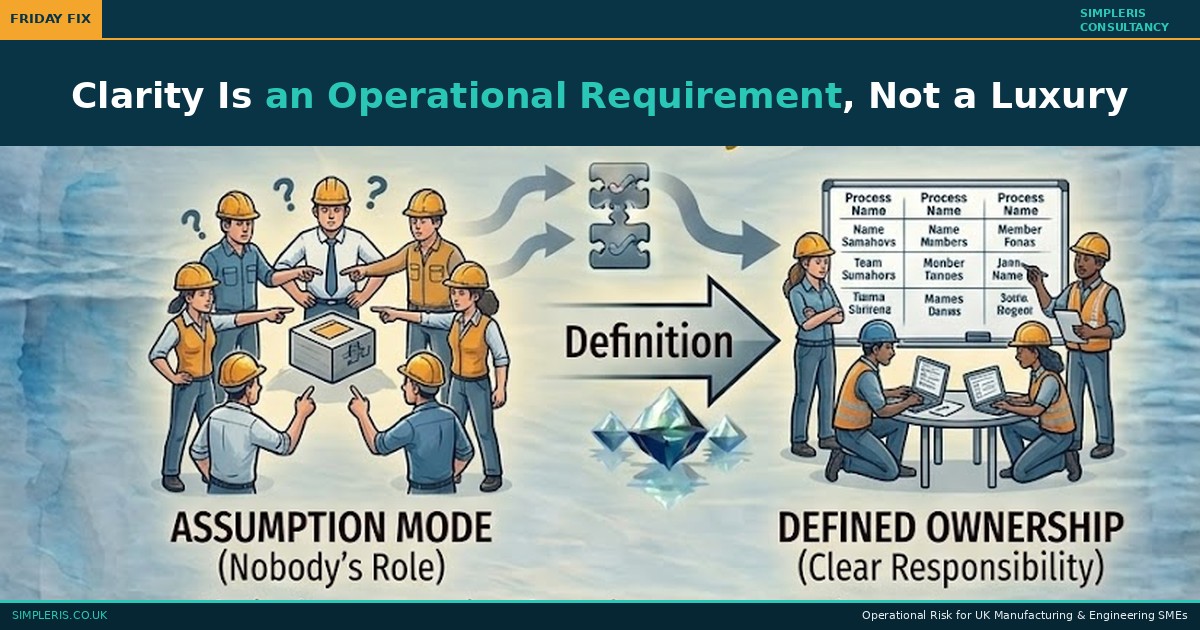
Clarity Is an Operational Requirement, Not a Luxury
A customer complaint sits in the inbox unresolved for two days. Everyone on the team knows it needs dealing with. Two people both believed the other had picked it up. A third assumed it was being escalated through a different route. When you finally reach the customer, the team cannot explain what happened. The complaint was not the problem. The absence of a named owner was.
Pain: Your team makes assumptions because roles were never defined.
This is not a motivation problem and it is not a people problem. Your team is not avoiding responsibility; they are filling a gap that should have been closed by design. In a small manufacturing or engineering business, many role boundaries are inherited from the founding era. When the business was smaller, you or a trusted senior handled most things, and everyone knew informally who to go to for what. That informal map worked because the team was small enough for everyone to carry it in their heads. As the business grows and new people join, that map stops being shared automatically. New starters cannot read the room the way the original team could. They act on what they believe is expected, and when expectations are never made explicit, the result is inconsistency: sometimes a task gets done by two people simultaneously, sometimes by neither.
Operational risk grows in exactly this gap. When roles are assumed rather than defined, decisions get duplicated, delayed or quietly dropped. When no one is named as the owner of a process, that process runs on goodwill and habit rather than on a defined structure. That works until the people who carry the informal map in their heads are absent, busy with something urgent, or new enough not to know the habits yet. Ownership and decision clarity risk is one of the six pillars of operational risk precisely because the absence of defined ownership is structural rather than personal. It does not resolve itself through culture or effort alone. It surfaces at the worst possible moment: the handover that nobody knew they owned, the customer call that went unanswered, the decision that sat on two desks for a week because both managers assumed the other was carrying it.
The gap becomes most visible under pressure. A senior team member leaves, taking with them the informal knowledge of who handles what and how decisions flow. A period of high demand means the experienced operator who normally catches the problems is stretched too thin to catch them. A new customer brings a type of complaint the team has not dealt with before, and nobody is certain who is supposed to own the response. In each case, the same underlying structure produces the same result: a task falls through not because people failed but because the task was assumed rather than assigned. The business absorbs the cost through missed deadlines, duplicated effort, or direct escalation to the owner. None of those responses change anything at the structural level. The ambiguity resets and waits for the next moment of pressure to surface again.
Fix: Write the owner for one critical process or decision this week.
Pick one process or recurring decision that currently relies on an assumption about who is responsible. Not a complete role review. Not a job description rewrite. One process, this week. Name the owner. Write it down in a place the relevant team members can see it. Then tell the people involved that the written record is now the standing rule. This is the smallest unit of systemised role clarity: a single ownership record that removes a single ambiguity. It is not bureaucracy. It is the minimum structure needed to replace assumption with accountability. The reason it works is not that the team lacked the information before; often they already sensed who probably should own the process. But informal sensing is not the same as an explicit record. Making it explicit removes the hesitation that informal sensing always leaves behind.
The effect spreads quickly. Once one process has a named owner, the team around it stops second-guessing. Related decisions get made faster because the owner is visible and the decision point is clear. Tasks stop sitting unclaimed in the space between roles. You will also find that naming one owner surfaces two or three adjacent processes that need the same treatment. Start with the one that causes the most friction or creates the most delay. Write the owner down. Share it with the people it affects. Then move to the next one. Clarity at the role level is not a trait of large, well-resourced businesses. It is a choice that any business can make this week, for one process, in writing.
Where did a lack of clarity impact your results this week?
Related: When Standards Slip, Systems Were Never Clear
This post is part of the Friday Fix series, a weekly operational fix for UK manufacturing and engineering business owners.