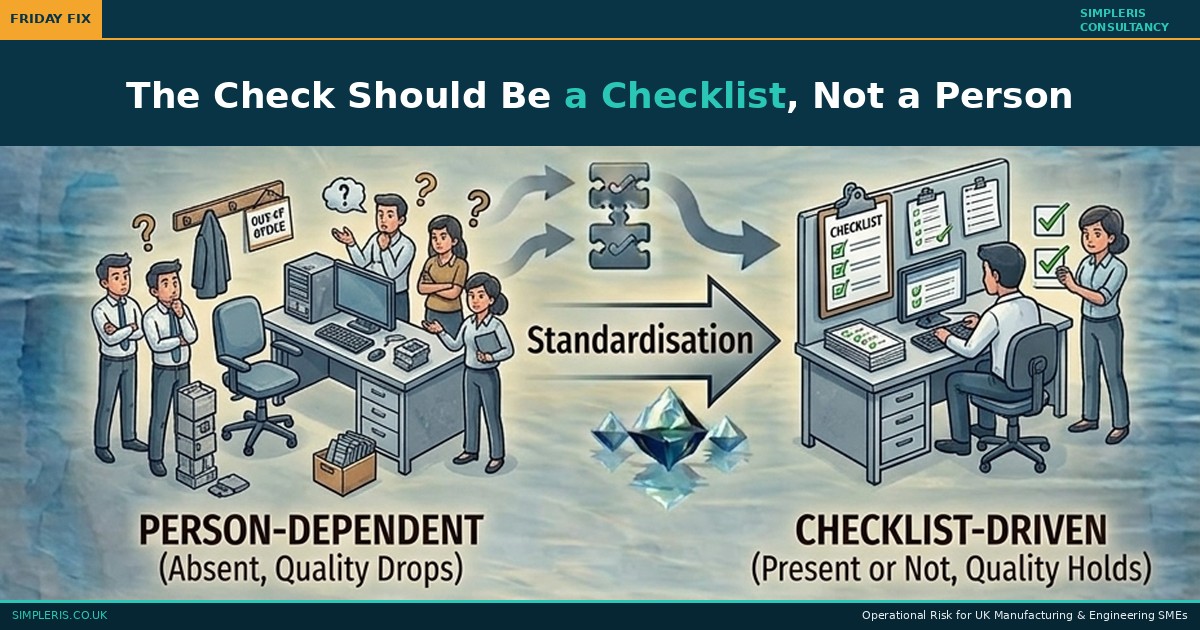
The Check Should Be a Checklist, Not a Person
The senior technician goes on holiday. Halfway through the first day, the quality call comes. A batch has gone out that would not have passed under normal conditions. When the tech is back, they review the work and identify the three checks that were skipped. Everyone knows which checks they are. The problem is that they are not written anywhere that makes it obvious what to do, in what order, without the tech present.
Pain: Quality drops every time the senior tech is off.
This is not a staffing problem. It is a documentation problem with a staffing symptom. The technician's value to the business is not in their presence on any given day. It is in the checks they run, the tolerances they know to look for, and the judgements they make at each decision point. When that knowledge is not documented, it stays personal. The business retains it only while that person is on site, available, and able to be asked. Process consistency risk builds wherever the quality of output depends on who is present rather than what the process requires. A quality check that only happens reliably when the right person is there is not a quality system. It is a quality dependency.
There is a hidden cost in the reverse direction too. When one person mentally carries the checklist, gaps in the written procedure accumulate undetected. The tech makes adjustments from experience without registering them as adjustments. A slightly different inspection sequence, a tolerance threshold held to a tighter standard than the procedure specifies, an additional visual check at a step that used to produce occasional rejects. Those invisible steps are not taught, not documented, and not available to anyone else. The first time someone else runs the check without them, the invisible steps are missing. The output reflects it. The business absorbs a quality failure that traces back not to incompetence but to undocumented expertise.
The pattern tends to be self-reinforcing. Because the tech is reliable, the informal system works well enough that documenting it never becomes urgent. The cost of not documenting is invisible on the days the tech is present, which is most days. The cost surfaces only when they are absent, at which point the response is reactive rather than preventive. The batch goes out wrong. The tech comes back and fixes the process by hand. The informal knowledge returns with them. The underlying gap stays open and resets for the next absence. Over time, the business becomes more dependent on the individual rather than less, because each successful recovery reinforces the assumption that having the right person present is the solution, when the actual solution is making the process survivable without them.
Fix: Make the check a checklist, not a person.
Ask the senior tech to write down every quality check they run during one typical batch. Not what they think they should do. What they actually do. Capture the sequence, the specific points of inspection, the tolerance thresholds, and what an unacceptable result looks like at each step. This is not a theoretical procedure. It is a record of what the most reliable operator in your business actually does to produce consistent output. That distinction matters. Procedures written at a policy level often miss the practical detail that makes quality repeatable. The tech's actual practice is where that detail lives.
Then test the list with a second operator: can they complete the check independently and produce consistent results? Every point that requires a question to complete is a gap in the document. Close it. The documented checklist is not a replacement for the tech's skill. It is the mechanism that makes their skill repeatable when they are not present. Once it exists, two things change. First, the business retains the quality standard regardless of who is on shift. Second, the senior tech can take leave, be promoted, or move to more complex work without taking the quality system with them. The check moves from being a personal capability to being a business asset. Quality held by one person stays fragile. Quality held by a checklist holds regardless of who turns up.
Which quality check in your business still depends on the right person being there?
This post is part of the Friday Fix series, a weekly operational fix for UK manufacturing and engineering business owners.