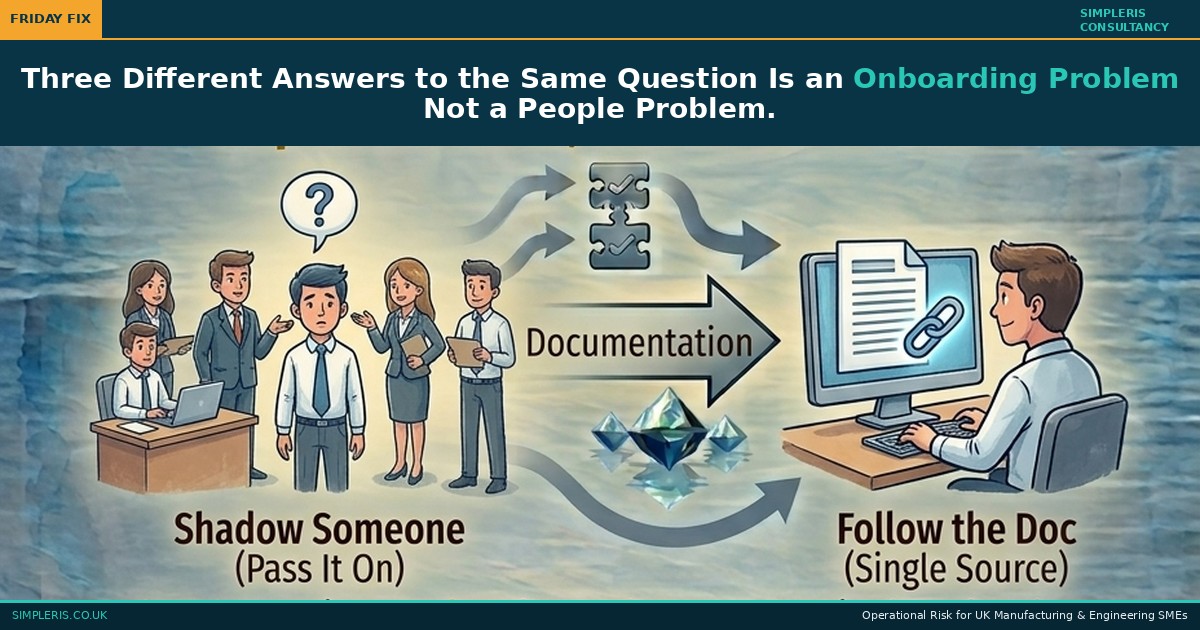
Three People Asked. Three Different Answers. That Is Your Onboarding Problem.
Your new starter needed to know how something worked. They asked the first person they could find. That person was mid-task and gave a short answer. An hour later the starter had a follow-up question and asked someone else. That person gave a slightly different explanation. By end of day they had three versions of how the same thing gets done, and no way to know which one to follow.
Pain: New starter asked 3 people "how do we do that here" today.
This is not a communication problem and it is not the team's fault. When there is no single documented source for how work gets done, new people have no choice but to ask. They ask whoever is nearby, whoever seems approachable, whoever looks least busy. Each person gives the answer they know, drawn from their own experience of how the task evolved over time. The answers are all honest. They are also inconsistent, because without a written standard, the task has quietly become different things to different people.
This is onboarding and enablement risk in its most common form. The person newest to the business pays the highest price for the absence of a written standard. They spend their first weeks piecing together an understanding of how things work from fragments, contradictions, and whoever had time to explain. They are slow to become productive not because they lack ability but because the business has given them no structured path to follow. Meanwhile, the people they are asking are interrupted repeatedly, doing informal training that consumes time they do not have and produces an outcome -- a new hire who is still not fully up to speed after three months -- that nobody planned for.
The shadowing model compounds this. When onboarding means following someone experienced around the floor and picking up how they work, the new starter inherits that person's habits, shortcuts, and interpretations. The standard, if there was one, gets diluted with every hire. Over time, the business ends up with as many versions of each process as it has people who have done it.
Fix: Capture the answer once, link to it forever.
The fix does not require a documentation project. It requires a habit. The next time a new or recent team member asks a question that already has a known answer, do two things: answer them, and then write the answer down before you move on. One sentence is enough to start. The question and the answer in the same place, findable by name or by the task it relates to.
The location matters. A single shared document, a page in your operations system, a linked note attached to the relevant process -- somewhere the team can reach without asking a person first. Over time, as more questions get captured this way, the document becomes your onboarding path: built from the real questions new starters have, in the order they naturally encounter them. This is the principle behind the SYSTEMology approach to onboarding design. You are not writing a manual from scratch; you are capturing institutional knowledge at the moment it surfaces. The new starter who asks a question today is showing you exactly what the business needs to document. Teams that build this habit find that each new hire gets up to speed faster than the last, because the documented path grows more complete with every hire that goes through it. The shadowing model does not disappear overnight, but it stops being the only path.
What question did a team member ask this week that could have been answered by a document?
This post is part of the Friday Fix series, a weekly operational fix for UK manufacturing and engineering business owners.