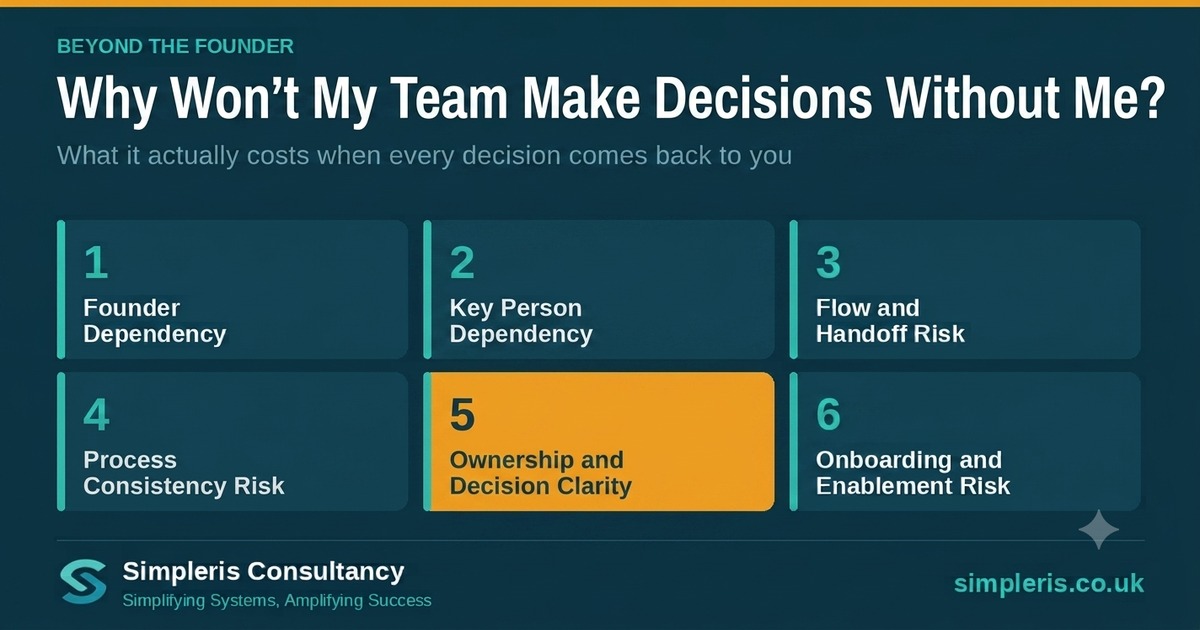
Why Won't My Team Make Decisions Without Me?
Everything comes back to you. Not the big calls, the small ones too. A pricing exception, a scheduling clash, a supplier query that could have gone either way. Your team asks first, every time, and you have started to wonder whether you are the bottleneck in your own business.
Why Won't My Team Make Decisions Without Me?
Because nobody has told them a specific decision is genuinely theirs to make. Faced with any ambiguity, the safe move for a capable employee is to check with the person who has always made the call before. That is not a confidence problem in your team. It is an unclear-ownership problem, and it will not resolve itself just because the team gets more experienced or the business gets older.
Most owners read this as a people issue and respond by hiring more experienced staff, or repeating instructions more clearly. Neither fixes it, because the actual gap is not skill or clarity of instruction. It is that no decision has ever been formally handed over, with a boundary attached, so everyone defaults to the one behaviour that has always worked: ask the founder.
This is a different risk from Founder Dependency, even though the two look similar from the outside. Founder Dependency is about the business needing you present to function at all. Ownership and Decision Clarity is narrower and, in some ways, more frustrating: you can be present, you can have a capable team in place, and decisions still land on your desk anyway, because nobody was ever told which ones belong to them.
Why Is Everything Still Coming Through Me Even Though I Have A Team?
Because your team can grow in headcount without ownership growing alongside it. Hiring adds hands and hours. It does not automatically add authority, unless authority is explicitly given away, decision by decision.
Here is what that looks like in practice. You hire a production supervisor to take pressure off the floor. Six months later, they are running the shift competently, but they still walk over every time a customer wants a delivery date moved, because nobody ever told them that call was theirs. You have more people and the same number of decision-makers you started with, which is you. The team expanded. The decision-making did not expand with it.
How Do I Stop Being The Bottleneck In My Own Business?
Start by treating it as a measurement problem, not a willpower problem. For one week, note every decision that reaches you that someone else could plausibly have made. Do not act on this list yet. Just capture it.
You will typically find the same handful of decision types on repeat: a pricing exception, a scheduling call, a judgement about which supplier to use, an answer to a question a customer has asked before. Being asked constantly is not proof that you are indispensable. It is proof that nobody has been told they are allowed to decide without you, and the fix starts with naming exactly which decisions that applies to.
Do not skip the measurement step, even though it feels slower than just fixing things as they come up. Owners who jump straight to "delegate everything" tend to hand over either the wrong decisions, or the right decisions with no boundary attached, and both create the kind of bad outcome that makes the next attempt at delegation even harder to trust.
What Decisions Should I Delegate First?
Start with decisions that are frequent and low-risk, not decisions that are rare and high-stakes. A daily scheduling call that is easy to reverse if it goes wrong is a far better first delegation than a once-a-year contract negotiation that genuinely needs your judgement.
A simple way to sort the list from the previous step: for each recurring decision, ask two questions. How often does it come up, and how bad is it if someone gets it wrong? Decisions that are frequent and low-cost to reverse are your starting list. Delegate those first, build confidence and a track record on both sides, and only then move toward the decisions that carry more weight.
How Do I Create A Decision-Making Framework For My Team?
Keep it to four things per decision, written down once. What the decision is, specifically. Who owns it. What limits apply, such as a value threshold or a scope boundary. And what triggers an escalation back to you.
For example: "Rebooking a delivery slot within five working days of the original date is the production supervisor's call. Anything further out, or any request involving a discount, escalates to me." That is a complete decision framework in two sentences. It removes the ambiguity that was forcing the question to you in the first place, without removing your visibility into the decisions that genuinely still need it.
Do this for the handful of decisions from your audit, not the whole business at once. A short, specific list that is actually followed beats a long policy document that sits in a drawer.
A useful test for whether a decision is genuinely ready to hand over: could the person receiving it explain it back to a colleague in one sentence, including when they should still come to you? If they cannot, the framework is not finished yet, no matter how confident you feel about it.
What's The Difference Between Delegation And Abdication?
Delegation hands over a specific decision with a boundary attached, and keeps you accountable for the outcome even though you are not making the call yourself. Abdication is telling someone to "just handle it" with no framework, and then stepping in to criticise the outcome after the fact.
This distinction is worth sitting with, because it is usually the real reason founders hesitate to delegate at all. Handing over a decision with no framework does tend to go badly, which then looks like proof that the team cannot be trusted with it. The actual lesson is the opposite: it was not a delegation, it was an abdication, and the fix is the same four-part framework above, not reversing course and taking the decision back permanently.
Done properly, delegation is not a loss of control. It is the only version of control that survives you being on holiday, in a meeting, or simply not the first person someone thinks to ask.
The test that tells the two apart is simple: if a decision goes wrong, is there a written boundary to check it against, or only your memory of what you meant when you said "just sort it"? A written boundary means you delegated. A memory means you abdicated, and the outcome was always going to be a coin toss.
You cannot fix what you have not measured. Take the free Simpleris® Operational Risk Assessment to see how Ownership and Decision Clarity compares to the other five domains in your business, and which one is actually costing you the most.
If you want to see how we build the decision-making systems that let your team act without you, take a look at our operational design approach.
Related: Six Places Operational Risk Hides in a Growing Manufacturing Business
Related: Why Does My Business Stop When I Take a Day Off?
Related: Yes in the Meeting Means Nothing Without an Owner and a Date