Every H2 Problem Has H1 Roots
Today is 1 July.
If you genuinely completed every operational risk intention you set in January, take the day off.
Most people reading this did not. And that is not a personal failure. It is a structural one.
Here is what actually happens between January and June in most engineering and manufacturing businesses.
January: "We really need to sort out that risk."
February: "We are on it."
March: Still on it.
April: Deprioritised. An urgent thing came up.
May: What was that thing we were going to sort?
June: H1 review. Nobody mentions it.
The risk did not go away. It just stopped being named.
What H1 Deferred, H2 Inherits
The second half of the year does not arrive with a clean slate. It arrives with everything the first half left unresolved.
The roster change you were going to protect against. The process that only works when one person runs it. The handoff between teams that loses information every time. The rework cycle you normalised because fixing it never made the agenda.
Those risks did not hibernate during Q1 and Q2. They carried on building, quietly, in the background. The business adapted around them, which made them harder to see, which made them easier to defer again.
H2 Planning Without H1 Audit Is Not Planning
This is where the "fresh start" framing becomes a problem.
Every year the second half brings the same content. "New half, fresh start." "Eyes forward." "H2 is where we make it happen." The intention behind it is sound. The problem is the premise.
If you are writing H2 intentions without first auditing why H1 did not go to plan, you are not planning. You are performing.
A new goal sitting on top of an unresolved risk does not resolve the risk. It adds a second thing to manage.
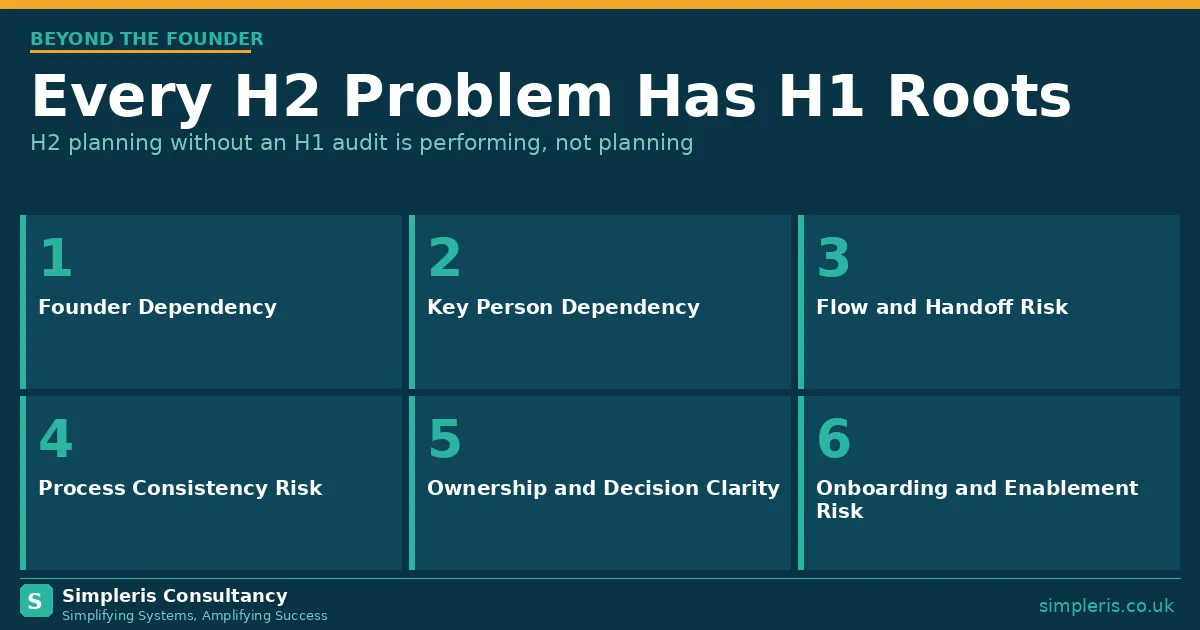
The Six Domains Where H1 Debt Accumulates
Operational risk does not build uniformly. It concentrates in six specific domains, and each one attracts the kind of deferral that looks reasonable at the time.
Founder Dependency. The decisions that still need the founder to unblock them are not an accident. They are a design that was never changed.
Key Person Dependency. The operator whose absence makes the line twitchy was never documented because there was always something more urgent.
Flow and Handoff Risk. The information that goes missing between teams keeps going missing because fixing the handoff never felt like a crisis, just an inconvenience.
Process Consistency Risk. The variation in how the same job gets done depending on who does it was flagged in January and is still there in June.
Ownership and Decision Clarity. Decisions that escalate unnecessarily do so because nobody clarified who owns them, and that conversation kept being postponed.
Onboarding and Enablement Risk. The new hire who took six months to become useful was a warning. The next one is on track to take just as long.
Each of these was there at the start of the year. Each had a January intention behind it. Most were not resolved.
You can read more about how these six domains build together in The Six Places Operational Risk Hides in a Growing Manufacturing Business.
What a Genuine H2 Audit Looks Like
It is not a lengthy exercise. It is an honest half-day with one question per domain: did anything actually change here since January, or did we defer this again?
If the answer is deferral in more than two or three domains, the issue is not prioritisation. It is that the risk is not visible enough to compete with operational firefighting. That is a structural problem, not a motivation problem, and it needs a structural answer.
The Operational Risk Assessment was built for exactly this moment. It takes seven minutes, scores all six domains, and surfaces where risk is concentrating in the areas most likely to limit your second half. Not as a theoretical exercise: as a starting point for actually changing something.
If you are writing H2 goals this week, take twenty minutes first. See how Simpleris works and run the free assessment below before you commit to the next six months.
Go into the second half knowing what you are actually dealing with, not just what you intend to address.
Because H2 does not give you a fresh start. It gives you a reckoning with everything you deferred.
And if you genuinely completed everything you set out to in H1: take the day off. You have probably already got a plan for H2 too.
Martin Cable is the founder of Simpleris Consultancy. He works with owners, CEOs and MDs of growing UK manufacturing and engineering businesses to reduce operational risk and build businesses that work without them.