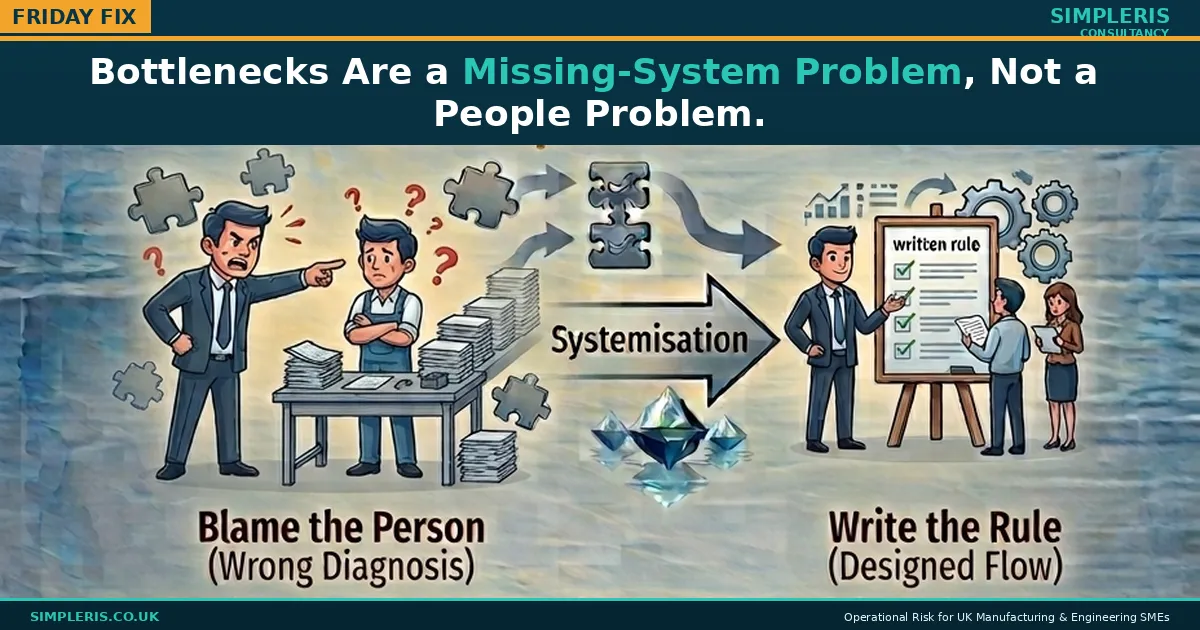
Bottlenecks Are Not People Problems
When a process keeps stalling at the same point, the instinct is to look at the person standing at that point. Usually wrongly.
Pain: A bottleneck keeps forming at the same point and you find yourself blaming the person standing there.
In a growing operations-led business, bottlenecks build at the joins. A piece of work waits for a decision. An order waits for someone to interpret a special case. A delivery waits because the only person who knows the spec is in a meeting. Look across all of these and a pattern emerges. The bottlenecks are not caused by lazy people, slow people or careless people. They are caused by missing systems, missing rules and missing handover points.
This matters because it changes who you have to fix. If a bottleneck is a people problem, the answer is to manage or replace the person, which is slow, expensive and rarely solves the next instance. If a bottleneck is a missing-system problem, the answer is to design the work so the bottleneck cannot form.
Fix: Write the missing decision rule and publish it. The bottleneck disappears without changing the person.
Take the most chronic delay in your business this month. Where does it sit, who is involved at that point, what decision are they having to make in their head every time it comes round? Now write down the rule. Decide what triggers it, who is allowed to make it, what the output should be. Two paragraphs of plain English is plenty. Publish it where the team can find it.
You have removed one bottleneck without changing a single person. The same fix protects every future person who walks into that role. This is the foundation of systemising the business so it runs without depending on heroics.
Where did a bottleneck slow things down for you this week, and what missing rule was sitting underneath it?
Related: When Standards Slip, Systems Were Never Clear
More in the Friday Fix series.