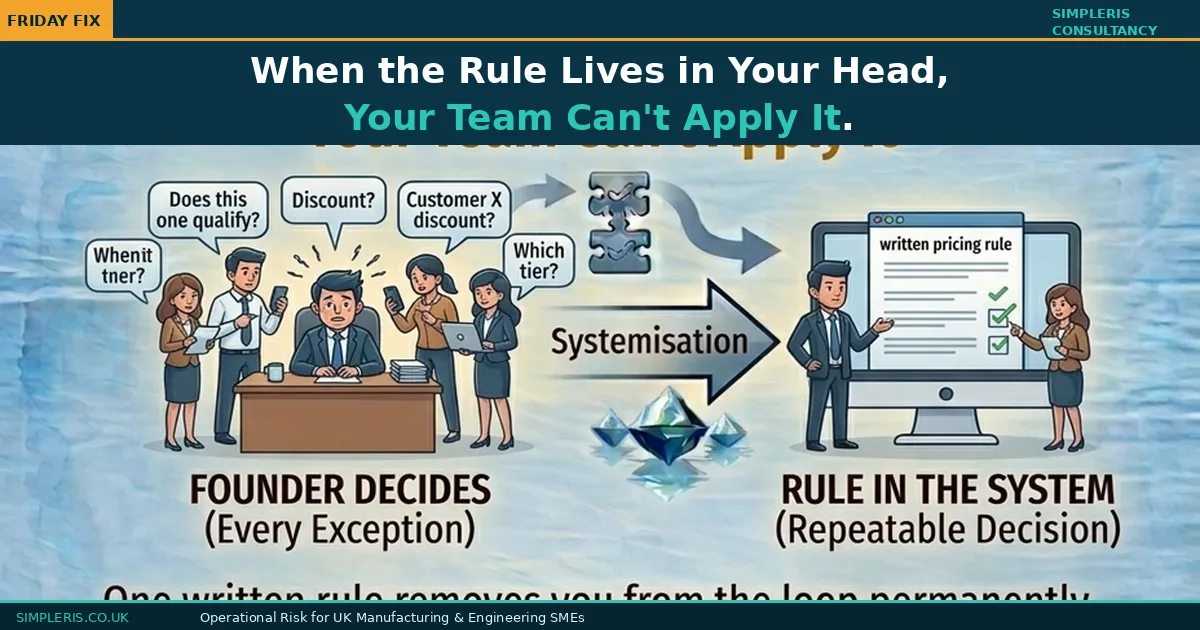
You know why that customer gets the discount. Your team doesn't.
A customer calls and asks about pricing. The salesperson puts the call on hold and messages you. Not because they cannot handle it. Because the rule only exists in your head.
Pain: Only you know why that customer gets the discount.
When pricing decisions, approval thresholds and exception rules live in one person's memory, that person becomes a checkpoint for every judgment call in the business. It does not feel like a risk. It feels like staying close to the business.
But the cost accumulates. Sales pauses while waiting for a response. Teams second-guess themselves on similar calls. Margin drifts because no one outside the founder knows where the line is. The founder's availability becomes a constraint on the speed of the whole operation. This is Founder Dependency risk, and it is one of the most common patterns in owner-led manufacturing businesses.
Fix: Put the rule in the system, not in your head.
Write the rule down. One sentence is enough: "Customers who order more than X per quarter get Y% off." Post it where the sales team works. Once written, anyone can apply it. You stop being the decision point. The knowledge becomes a business asset rather than a personal habit, and it stays in the business if you step away. This is what building an operable system looks like at the smallest useful scale.
Which pricing, approval or exception decisions in your business still depend on you being in the loop?
Related: Clarity Is an Operational Requirement, Not a Luxury
Related: Write Down What Your Team Is Authorised to Decide
Related: Two Years Without a Proper Week Off Is a System Problem, Not a Dedication Problem
Explore more in the Friday Fix series at simpleris.co.uk/insights