Why Does My Business Stop When I Take a Day Off?
Take a day off, and watch what happens. If decisions stall, approvals wait, and problems queue up until you are back, that is not proof of how hard you work. It is Founder Dependency, and it is worth naming properly before you can fix it.
What Is Founder Dependency?
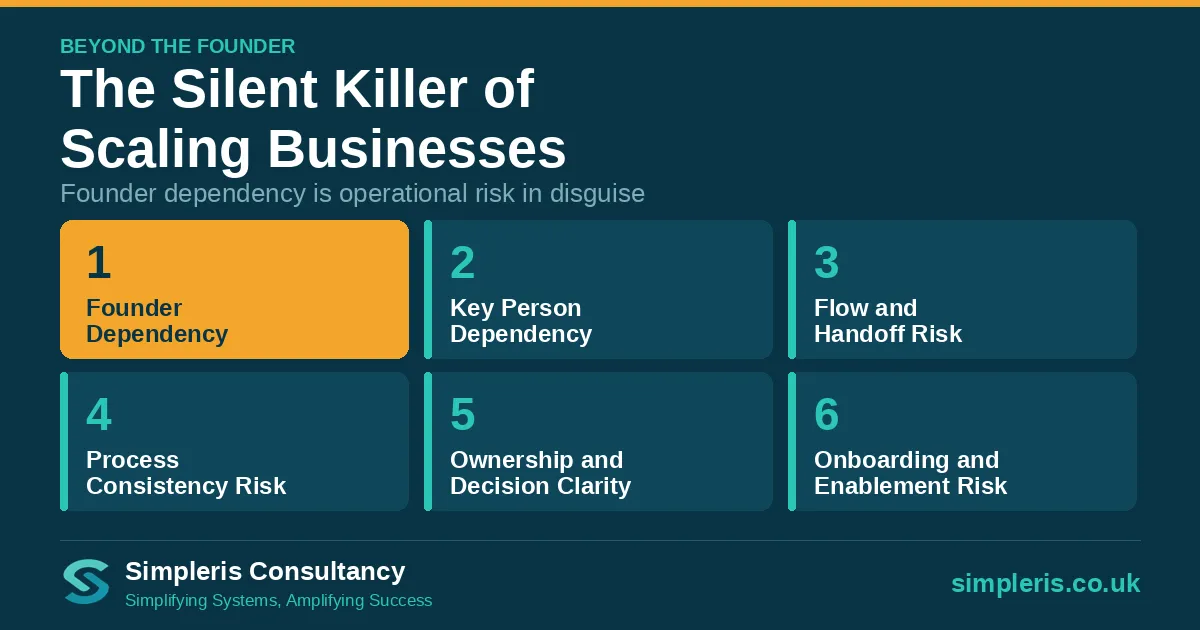
Founder Dependency is the risk that decisions, approvals and judgement calls all flow through one person, so when that person is unavailable, things slow or stop. It is the first of six domains of operational risk, and usually the one that builds up first, because in the early stage of a business it is not a flaw. It is often the only way the business survives its first few years.
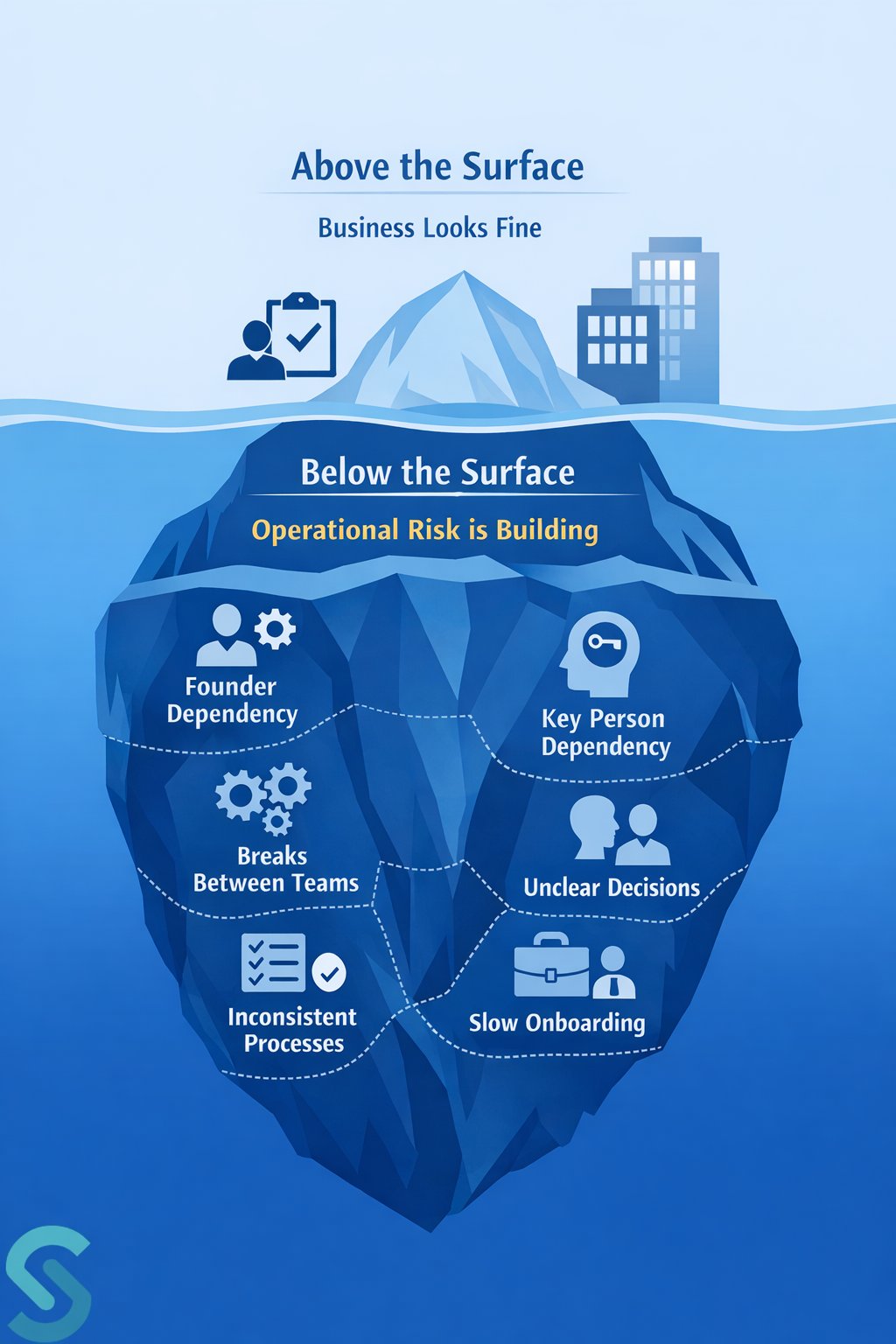
Most founders are watching the wrong horizon for threats. The worry goes to market shifts, a competitor's new move, or the wider economy, because those are visible and external. The thing actually shaping how fast the business can grow is quieter, and it is inside the building. Operational risk disguises itself as hard work, or as being indispensable. In reality, it is a structural crack: the business has built up around you rather than around systems.
How Do I Know If My Business Is Too Dependent On Me?
Founder Dependency is not one dramatic failure. It is a pattern of small ones, repeated so often they stop registering as a problem at all.
Everything goes through you, even decisions your team is capable of making alone.
The same question reaches you twice in a week, from two different people, because the answer only exists in your head.
Work backs up on the days you are out, then floods back the moment you return.
You cannot take a proper holiday without something slipping, and you already know it before you book it.
Nothing moves without a quick check with you first, on almost everything.
None of this looks like a failure. It looks like commitment. That is what makes it hard to see from the inside.
Can A Business Actually Run Without The Founder Being Involved Every Day?
Yes, but not by accident. It takes the habit being deliberately retired, not just less attention from you.
The trap is that the habit does not retire itself once the business outgrows the stage that needed it. I have worked with founders who were still the only person who truly understood how a key product was delivered, or how a specific class of decision got made, years after they had the team to do it themselves. When they stepped away, even for a few days, the business did not fail outright. It just stopped moving.
Here is what that looks like in practice. A production manager gets a query about a late delivery from a long-standing customer. The standard response would resolve it, but this customer has history, so the manager pauses and waits for the founder to weigh in before replying. The founder is in back-to-back meetings and does not see the message until the evening. The customer chases twice in the meantime. Nothing here is anyone's fault. The manager was right to be cautious, and the founder was right to want visibility on a sensitive account. The actual problem is that the judgement call about which customers need special handling, and what "special handling" means in practice, has never been written down anywhere except the founder's head.
Multiply that one query by every borderline decision that crosses a founder's desk in a week, and the pattern becomes the ceiling on how fast the business can move:
Decisions stall because no one else has the context or the authority to make them.
Teams wait for approval instead of acting on judgement they are perfectly capable of using.
Growth flattens, because the founder has quietly become the ceiling on how fast anything can move.
If the business cannot function without you in the room, the business is fragile, not impressive. That distinction is the starting point for reducing operational risk rather than just working harder inside it.
What Does Founder Dependency Actually Cost A Manufacturing Business?
Founder Dependency rarely shows up on a profit and loss statement, which is part of why it survives so long unaddressed. But it has a cost, and it lands in three places.
Growth has a ceiling. If every meaningful decision needs you, the business cannot grow faster than your own capacity to make decisions. Adding people does not raise that ceiling. It just adds more people waiting on you.
The business is worth less than it looks. A buyer, an investor, or your own future self trying to step back all ask the same question: what happens to this business without the founder? If the honest answer is "it slows down significantly", that uncertainty gets priced in, whether the conversation is a formal valuation or simply your own confidence about taking real time off.
You pay for it personally. Evenings and holidays interrupted by questions only you can answer. A team that quietly disengages from decisions they are capable of making, because experience has taught them to wait for you instead. None of this shows up as a single bad day. It shows up as the slow accumulation of a business that owns you, rather than the other way round.
None of this is inevitable. It is the predictable result of a habit that has not been re-examined since the business was a different size.
How Do I Reduce Founder Dependency Without Losing Control?
Reducing Founder Dependency does not mean stepping back and hoping the business copes without you. It means building what should have been there instead of your judgement all along: clear ownership, decision rules, and consistent ways of working that do not need your presence to operate. That is not losing control. It is trading control-through-presence for control-through-clarity, which is the only version of control that survives a day off.
In practice, that comes down to three steps.
Map the decisions that only you make. Not the big strategic calls. The small, repeated ones: the pricing exception, the approval before a job ships, the answer you give the same question every time it lands in your inbox.
Write the decision rule down, once. Turn "check with me" into a rule the next person can apply themselves, in the same words you would use if you were standing next to them.
Test it without you. Take the day off, or the week, and let the rule run without stepping in to rescue it. If it holds, the risk is genuinely reduced. If it breaks, you have found the next thing to fix, cheaply, instead of finding out the hard way.
This is not about documenting everything at once. It is about starting with the decisions that reach you most often, because those are the ones quietly setting the ceiling on how fast your business can grow.
Two Friday Fix examples show this at the smallest scale: if the same question keeps reaching you, the answer only needs writing down once, and an undocumented pricing exception is a rule waiting to be written, not a judgement call waiting to be repeated.
How Long Does It Take To Build A Business That Runs Without The Founder?
Longer than a weekend, shorter than most founders assume. The three-step process above does not need to run across the whole business at once. Run it on the single decision that reaches you most often, and you will usually see the ceiling move within a few weeks. The full picture, where most day-to-day decisions genuinely do not need you, tends to take months of steady, unglamorous work rather than one big reorganisation. The founders who get there fastest are the ones who test the rule properly, by actually stepping away, rather than declaring victory the day the document is written.
Founder Dependency is not the only version of this risk. The same pattern shows up in your best people, not just you, and that is Key Person Dependency, a related but separate domain with its own traps. If a single employee's memory, not yours, is what keeps a process running, see Passing the "Bus Test". For what that dependency actually costs in margin, growth and resilience, see The Operator Premium. And before reaching for the usual answer, read Why Cross-Training Fails (and the Smaller Thing That Works).
Most businesses do not stall because of a bad strategy. They stall because their operations cannot support the pace they are trying to grow at, and the single biggest point of that is usually the founder. You cannot fix what you have not measured. Take the free Operational Risk Assessment to see where Founder Dependency, and the other five domains, are costing you today, and what to prioritise first.
Reduce Founder Dependency and you get the thing every founder actually wants: a business that keeps running when you are not the one running it.
See also: Six Places Operational Risk Hides in a Growing Manufacturing Business
See also: Two Years Without a Proper Week Off Is a System Problem, Not a Dedication Problem