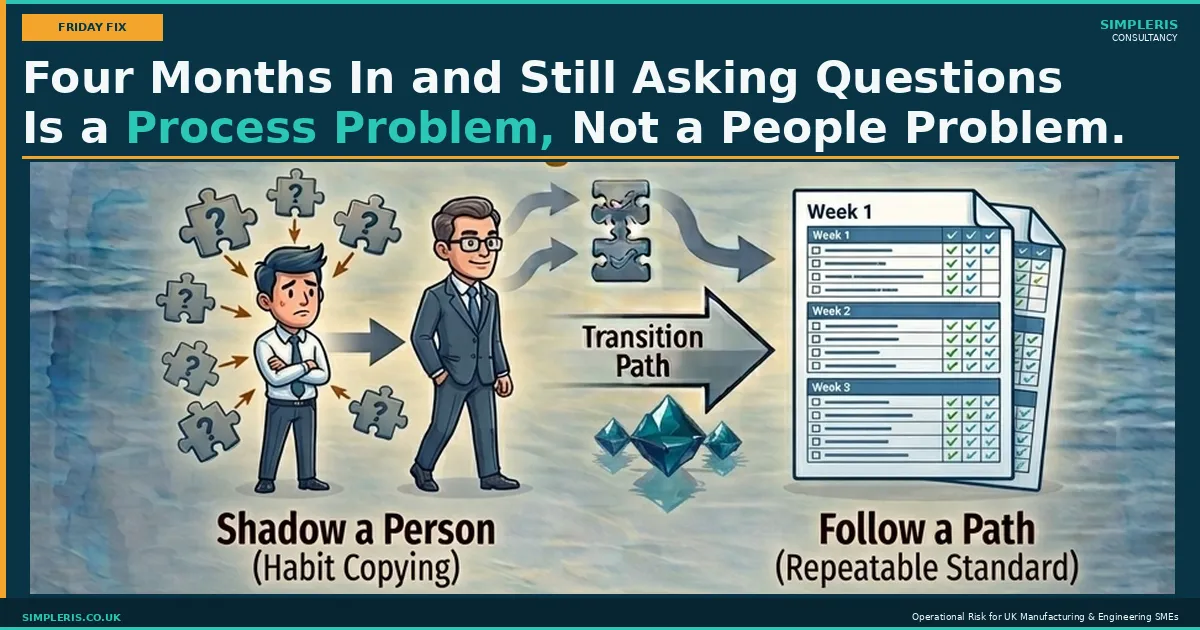
Four Months In, Still Asking Questions: A Process Problem
You hired them four months ago. They seem capable. They are trying. But they are still stopping the same senior person to ask the same types of questions.
And that senior person keeps stopping to answer.
This is not a performance issue. It is an onboarding design issue.
Why it happens
Most onboarding in growing UK manufacturing and engineering businesses runs through people. The new hire shadows the most experienced person available, absorbs their habits, picks up their shortcuts, and slowly learns enough to get by.
The problem is that what they learn is not your standard. It is that person's interpretation of your standard, including the workarounds they have developed over years, the informal exceptions they make, and the things they just know because they have been there long enough.
When the senior person is off, the new hire stalls. When you add a second starter, you now have two people pulling on the same expert. And when that expert eventually leaves, everything they were informally teaching walks out with them.
What it costs
The drag is easy to underestimate. Senior time spent answering repeat questions is not free. Slow time to independence stretches the onboarding period, delays productive output, and keeps your best operators in a support role when they should be doing the work only they can do. In businesses running on tight margins or limited capacity, that cost compounds every week.
The fix
Move onboarding from "shadow a person" to "follow a path".
A structured onboarding path does not need to be a training manual. It needs to capture the sequence: what a new hire should know by end of week one, week two, week four. What they should be able to do independently by month two. And where to find the answer when they do not know.
When that path exists in writing, new starters follow the system rather than the individual. Questions still happen, but they reduce quickly. Senior time returns to productive work. And the next hire gets the same standard as the last one.
This is Onboarding and Enablement Risk. It sits at the base of the iceberg because it takes time to surface as a visible problem, but it starts costing from day one.
Related: Three People Asked. Three Different Answers. That Is Your Onboarding Problem.
Related: When the Line Gets Twitchy Because One Person Is Off, the Knowledge Has Not Been Captured
If this pattern is familiar, it is worth understanding which of the six operational risk domains is pulling the most time from your senior people. The Operational Risk Assessment takes around five minutes and shows you where to focus first.